A battery maintainer is the quiet workhorse of any garage, dock, or shed. It is the device you clip onto a vehicle that sits for weeks at a time so the battery stays topped up and ready instead of slowly going flat. This guide rounds up a range of battery maintainers and smart trickle chargers for car, marine, and powersports use, drawn from current Amazon listings, and sorts them into clear roles so you can match one to the battery you actually own.
Modern maintainers do far more than the old plug-in trickle chargers of the past. The units here advertise automatic float modes, multi-stage charging, repair or desulfation steps, and in several cases support for more than one voltage and more than one battery chemistry. The spread below covers a versatile all-rounder, a classic set-and-forget float maintainer, a two-bank onboard marine unit, a heavy-duty higher-amperage charger, a compact powersports option, and a value pick for someone who just needs a single battery looked after.
How we chose these battery maintainers
These picks are editorial selections based on current Amazon product listings, not on our own bench work. We grouped the field by the job each unit is built to do, then read the listed specifications: output amperage, supported voltages, number of banks, the battery chemistries each maker names, and the operating modes described on the page. Amperage, voltage support, and battery-type compatibility are listing claims from each manufacturer, so we report them as stated rather than as measured numbers. We favored units with automatic multi-stage behavior, clearly described voltage support, and a stated role that lines up with a real use case, whether that is a daily driver left over winter, a motorcycle in storage, or a boat with two batteries onboard.
Our top picks
1. NOCO GENIUS2: best overall maintainer
The NOCO GENIUS2 earns the top spot because it tries to be the one unit that fits the most garages. The listing describes a 2A smart charger that supports both 6V and 12V batteries and names lead-acid, AGM, and lithium chemistries, along with a repair mode aimed at tired batteries. That flexibility is what makes it a strong default: if you own a car, a classic with a 6V system, a motorcycle, and a lawn tractor, a single GENIUS2 can rotate across all of them. It is a maintainer first, so it is built to stay connected for long stretches rather than to force-charge a dead pack in a hurry.
2. Battery Tender Plus: best smart maintainer
The Battery Tender Plus is the classic set-and-forget float maintainer, and the name is practically shorthand for the category. The listing describes a 12V unit rated at 1.25A that charges and then switches to an automatic float stage, which is the behavior you want for a battery that lives on the charger between uses. It markets itself as smarter than a plain trickle charger because it backs off once the battery is full instead of pushing current continuously. For a car or motorcycle that sits through a season, this is the no-drama choice.
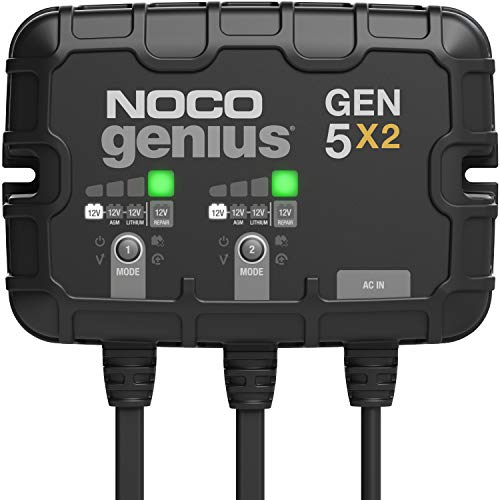
3. NOCO GEN5X2: best multi-bank for marine
Boats often carry more than one battery, and running separate chargers to each is a nuisance. The NOCO GEN5X2 is listed as a 12V, 10A, two-bank onboard marine charger and maintainer, meaning it mounts permanently and services two batteries at once, with 5A available per bank. An onboard marine unit like this is designed to be wired in place and left connected at the dock, so the house and starting batteries both stay topped up. If you have two batteries that need ongoing care rather than one, a multi-bank unit is the category to shop.
4. PCHH 0-15A Heavy-Duty: best heavy-duty charger
When a maintainer is not enough and you need real charging muscle, the PCHH heavy-duty unit steps up. The listing describes a 0 to 15A automatic charger that supports both 12V and 24V systems, with repair and winter modes and an automatic shutoff, and it names AGM among supported types. The wide 0 to 15A range is the headline: it can trickle a small battery or push a meaningful charge into a larger truck, boat, or equipment battery. The listed 24V support also opens it up to setups that the smaller 12V-only maintainers cannot touch.
5. Battery Tender Junior: best compact
For a motorcycle, ATV, or any small powersports battery, the Battery Tender Junior is the compact answer. The listing describes a 12V unit at 750mA that charges and then floats automatically, in a small weather-resistant housing meant to hang on or near the bike. The low output is a feature here, not a shortcoming, because a small battery does not want a large current fed into it over long storage. It is the kind of maintainer you clip on in autumn and forget until spring.
6. MOTOPOWER MP00205A: best value
The MOTOPOWER MP00205A rounds out the list as the value pick for someone who simply needs one 12V battery kept healthy. The listing describes an 800mA automatic charger that acts as a maintainer, trickle charger, and desulfator, cycling through its stages on its own. Desulfation is the step that tries to recover a battery that has sat too long and built up sulfate on its plates. For a single car, bike, or garden machine battery that spends most of the year parked, this is an uncomplicated way to keep it ready.
How to choose a battery maintainer
Maintainer vs charger vs jump starter. These three tools solve different problems. A maintainer delivers a small, managed current to hold a healthy battery at full charge over long idle periods. A charger pushes more current to refill a drained battery in a reasonable time. A jump starter is a separate device that provides a brief burst of power to crank an engine right now and does not keep the battery topped up afterward. Several units above blend the first two roles, charging and then maintaining, which is why the listings call them chargers and maintainers both.
Amperage for maintain vs charge. Lower outputs such as 750mA, 800mA, and 1.25A are aimed at maintaining and at slowly charging small batteries. Higher outputs like the 10A and 0 to 15A units are for charging larger batteries in less time, and they can still maintain afterward. Match the output to the battery size: a small motorcycle battery does not need a large charger, and a big deep-cycle or truck battery will top up painfully slowly on a tiny maintainer.
Voltage and battery chemistry compatibility. Check the voltage first. Most of these units handle 12V, some add 6V for older or classic vehicles, and the heavy-duty PCHH listing adds 24V. Then check chemistry. Lead-acid, AGM, and lithium batteries can want different charging profiles, and the listings state which chemistries each unit names. Using a profile intended for one chemistry on another is exactly the kind of mismatch to avoid.
Multi-bank for multiple batteries. If you maintain two or more batteries at once, such as a boat with a starting and a house battery, a multi-bank unit like the two-bank GEN5X2 lets one device service them independently instead of juggling single chargers.
Automatic float and desulfation modes. Automatic multi-stage behavior is the main reason to prefer a smart maintainer over a basic trickle charger. The unit charges, then floats, then tops up only as needed, which is what lets you leave it connected for weeks. Desulfation or repair modes, listed on several of these units, attempt to recover batteries that have been sitting, though results depend on the battery.
Weatherproofing for marine use. Onboard marine units such as the GEN5X2 are built to be mounted and left in a damp environment, so weather resistance and permanent mounting matter more there than for a charger that lives on a workbench.
Connectors. Most of these ship with both battery clamps and ring terminals. Ring terminals bolt to the posts so you can leave a pigtail on the battery and plug the maintainer in quickly, which is handy for a bike or boat you service often.
A note on matching and safety
Amperage, voltage support, and battery-type compatibility are claims from each product listing, so treat them as the starting point for matching, not as a promise of results. Always match the maintainer to your battery chemistry and voltage, and follow both the maker's instructions and your vehicle or vessel instructions when connecting and operating any of these units. If a listing and your battery disagree on voltage or chemistry, do not improvise.
The bottom line
For most people the NOCO GENIUS2 is the easiest unit to recommend because its listed 6V and 12V support and multiple chemistries let one device cover a mixed garage. Choose the Battery Tender Plus or Junior for simple set-and-forget maintaining, the GEN5X2 when you have two batteries on a boat, the PCHH when you need heavier charging and 24V support, and the MOTOPOWER as a straightforward value option for a single battery. Confirm the voltage and chemistry against your own battery before you buy, and you will have a unit that keeps it ready.