Dash Cameras
Best Dash Cameras for Front, Rear, and Cabin Coverage
7 picks compared
9 min read
ProductPickly is reader-supported. When you buy through links on our site, we may earn an affiliate commission at no extra cost to you. It never changes our picks.
The short answerFor most drivers the 70mai M310 Plus 4K Dash Cam is the standout pick, a single-front camera whose 4K sensor keeps number plates readable when you zoom in, paired with a wide 140 degree lens and an easy WiFi app. If you want sharp footage without the 4K storage load, the iZEEKER 2.5K is our value choice with a handy 3 inch screen, while the 3-channel front, rear and inside unit is the pick for rideshare and delivery drivers who need every angle. The Veement 1296P is a discreet app-driven front cam, the 1080P dual is a simple budget front and cabin option, the compact 70mai M310 adds parking mode in a tiny body, and the 2.5K front and cabin combo sharpens the front feed while keeping an interior view. Choose by the number of angles you need, resolution, and whether you want parking mode rather than by the biggest number on the box.
?How we pickedWe compare published specifications, safety certifications and thousands of verified owner reviews, and we do not physically test every unit. Read the full process in our review methodology.
70mai M310 Plus 4K Dash Cam Front
★★★★★ 4.6 / 5 Best overall
This is the camera we would fit first for most cars, because a 4K front sensor captures number plates and street signs with the kind of clarity that matters when footage becomes evidence. The 140 degree lens takes in a wide slice of the road without warping the center, and the WiFi app makes pulling clips off the camera far less of a chore than a card reader.
Channels Single front cameraResolution 4K UHD front recordingField of view 140 degree wide angleGood to know WiFi app, parking mode, night vision, voice control
- 4K detail that keeps plates readable when zoomed
- Wide 140 degree view without heavy edge distortion
- WiFi app makes saving and sharing clips simple
- Front only, so it does not cover the rear or cabin
- 4K files fill a card faster than 1080P
Best for: drivers who want the clearest possible single-front footage
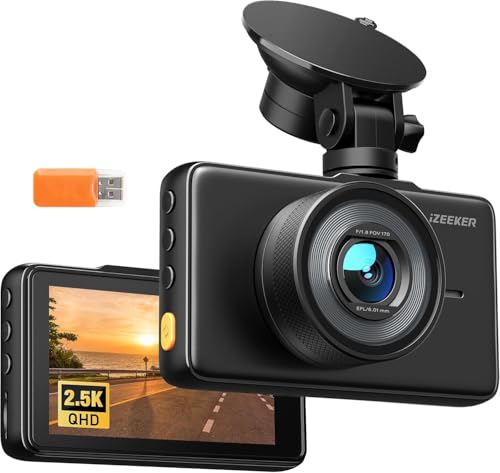
iZEEKER 2.5K Dash Cam Front 1440P QHD
★★★★★ 4.5 / 5 Best 2.5K value
A sensible middle ground for people who want sharper than 1080P footage without stepping all the way up to 4K storage demands. The 2.5K 1440P sensor holds detail well in daylight, and the 3 inch IPS screen is large enough to line up the view and scrub through clips on the camera itself rather than reaching for a phone every time.
Channels Single front cameraResolution 2.5K 1440P QHD frontDisplay 3 inch IPS screenGood to know Loop recording, G-sensor event lock
- 2.5K detail that beats standard 1080P cameras
- Large 3 inch screen for framing and playback
- Straightforward setup with on-screen menus
- Single channel, no rear coverage
- Night footage softens compared with the 4K pick
Best for: a sharp front camera with an easy on-device screen
Front and Rear 1080P 3 Channel Dash Cam
★★★★★ 4.4 / 5 Best 3 channel
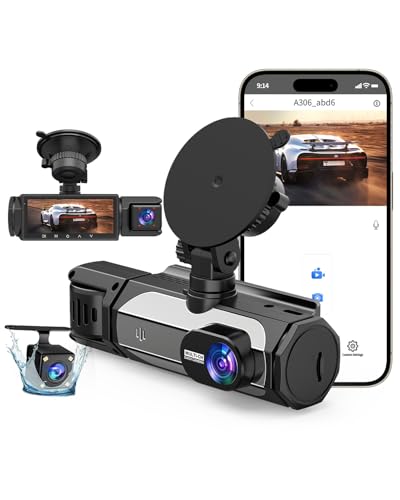
For anyone who wants eyes on every angle, this three channel setup records the road ahead, the view behind, and the cabin at the same time, which is exactly what rideshare and delivery drivers tend to ask for. It ships with a 32GB card and 24 hour parking support, so it is close to ready to run out of the box rather than needing a separate card purchase first.
Channels Front, rear and inside cabinResolution 1080P across channelsStorage 32GB card includedGood to know 5G WiFi, night vision, HDR, 24 hour parking
- Covers front, rear and cabin in one unit
- Includes a 32GB card to start recording sooner
- 24 hour parking support for incidents while parked
- 1080P per channel is lower detail than the 4K pick
- Three feeds mean more cabling to route and hide
Best for: rideshare and delivery drivers who need every angle
Veement 1296P Dash Cam Front with WiFi
★★★★★ 4.4 / 5 Best app driven front cam
A tidy front-only camera that leans on its phone app rather than a large screen, which keeps the unit compact enough to tuck behind the rear-view mirror and out of your eyeline. The 1296P sensor sits a step above plain 1080P for a little extra clarity, and reviewing footage happens on the app over WiFi rather than squinting at the device.
Channels Single front cameraResolution 1296P front recordingConnectivity Built-in WiFi with phone appGood to know Compact body designed to sit behind the mirror
- 1296P edges out standard 1080P for detail
- Compact body hides neatly behind the mirror
- App playback avoids fiddling with a card reader
- No on-camera screen for quick checks
- Front only, so no rear or cabin view
Best for: a discreet front camera you manage from your phone
1080P Dual Dash Cam Front and Inside
★★★★★ 4.3 / 5 Best budget cabin cam
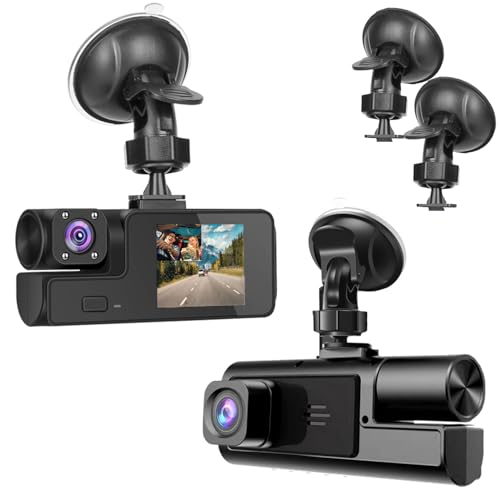
A no-frills pick for drivers who mainly want front-plus-cabin coverage without a lot of setup, using a wide 170 degree lens and WDR to keep both views usable. It records to a card you supply and keeps the feature list short, which suits someone who wants a basic two-way camera rather than app extras or high resolution.
Channels Front and inside cabinResolution 1080P dual recordingField of view 170 degree wide angleGood to know WDR, G-sensor, loop recording, 2 inch IPS screen
- Front and cabin coverage in a simple unit
- Wide 170 degree lens takes in more of the scene
- Easy to run with a minimal feature set
- Card is not included in the base version
- 1080P and no WiFi app limit it to the basics
Best for: a straightforward front and cabin camera on a tight budget
70mai Dash Cam M310 1296P QHD
★★★★★ 4.4 / 5 Best compact front cam
The smaller sibling to the 4K pick, this M310 keeps 70mai's clean app and reliable feel in a very compact 1296P body that all but disappears behind the mirror. It adds a time-lapse parking monitor and WDR for tricky light, so it is a strong choice when you want the 70mai app experience without the storage load of 4K.
Channels Single front cameraResolution 1296P QHD frontField of view 130 degree angleGood to know WiFi app, WDR, time-lapse parking monitor
- Very compact body that stays out of the way
- Clean 70mai app for setup and clip saving
- Time-lapse parking monitor for unattended cover
- Narrower 130 degree view than the wider picks
- Front only, no rear or cabin recording
Best for: a tiny front camera with the 70mai app and parking mode
2.5K Front and Inside Cabin Dash Cam
★★★★★ 4.3 / 5 Best sharp cabin combo
A two-way camera that lifts the front feed to 2.5K while keeping a 1080P cabin view, which is a useful step up if you want cabin coverage but were not happy with plain 1080P out front. It comes with a 32GB card, so the front-plus-inside pairing is ready to record without an extra purchase before you drive.
Channels Front and inside cabinResolution 2.5K front, 1080P insideStorage 32GB card includedGood to know Sharper front feed than most cabin combos
- Sharper 2.5K front feed than typical cabin cams
- Cabin camera included for interior coverage
- Ships with a 32GB card to record right away
- No rear-facing channel for the road behind
- Cabin feed stays at 1080P, not 2.5K
Best for: a front and cabin pair with a sharper front feed
A dash camera earns its place the moment a crash or a dispute comes down to your word against someone else, giving you a timestamped record of what actually happened on the road. The picks below run from a sharp 4K single-front camera to a three-angle setup that watches the road ahead, behind and inside the cabin, so you can match a camera to how you drive rather than buying more coverage than you need.
Single-front vs front and rear vs 3-channel
The first decision is how many angles you want to record, and it drives almost everything else. A single-front camera, like our 70mai 4K pick, covers the road ahead and handles the majority of everyday incidents while staying simple to fit and manage. Stepping up, a front and rear pairing adds the view behind for rear-end knocks, and a 3-channel unit such as the 1080P pick in this guide layers a cabin lens on top so the front, rear and interior all record at once. That extra coverage is exactly what rideshare and delivery drivers ask for, but it means more cameras to mount and more cable to route, so only reach for it if you genuinely need the interior and rear feeds.
Resolution and night vision, read honestly
Resolution matters because the footage is only useful if you can read a number plate from it. A 4K front sensor keeps plates legible even when you zoom in, 2.5K like the iZEEKER pick is a strong middle ground, and 1080P covers close-range detail without much room to spare. The catch is that higher resolution fills a memory card faster, so detail and recording time pull against each other. Night vision is where honesty helps most. WDR and HDR balance harsh headlights against dark surroundings and improve what you capture after sunset, but no dash cam sees in true darkness. Detail softens at night and fast-moving plates under poor lighting are the hardest to catch, so treat after-dark clips as solid supporting evidence rather than a promise that everything will be sharp.
Parking mode and hardwiring
Parking mode is what turns a dash cam from a driving recorder into round-the-clock cover, watching the car while it is off and saving a clip when the G-sensor feels an impact or motion crosses the frame. Several picks here, including both 70mai cameras and the 3-channel unit, support it. The practical hurdle is power. Most cars cut the 12V socket when the engine stops, so extended parking mode needs a hardwire kit that taps the fuse box, ideally one with a low-voltage cutoff that stops recording before your battery gets too low to start the car. For a quick errand the built-in buffer can be enough, but for overnight protection, plan on hardwiring and a sensible voltage cutoff.
Storage cards and the companion app
A dash cam is only as reliable as the card inside it. These cameras write in a constant loop, which wears out ordinary microSD cards quickly, so a high-endurance card built for continuous recording is worth the small extra outlay, especially in 4K or with parking mode running. Check the listing for the maximum supported size, since many cameras top out around 128GB or 256GB, and note that a few picks here ship with a 32GB card to get you started. The app decides how you live with the camera day to day. WiFi models like the 70mai and Veement cameras let you copy and share clips straight to a phone, which is far easier than a card reader, while screen-equipped picks such as the iZEEKER let you check footage on the device itself. Decide whether you prefer an on-camera screen or phone control, because that choice shapes how often you will actually pull footage off the camera.
Questions people ask
What is the difference between a single-front, front and rear, and 3-channel dash cam?
A single-front camera records only the road ahead, which is enough for most fender-bender and at-fault disputes and keeps setup simple. A front and rear pair adds a second camera for the view behind, useful for rear-end collisions. A 3-channel unit like the pick in this guide adds a cabin lens on top, recording front, rear or inside at once, which is why rideshare and delivery drivers tend to choose it.
Does resolution really matter on a dash cam?
Yes, because the whole point of the footage is being able to read a number plate or street sign after the fact. A 4K front camera such as our top pick keeps plates legible even when you zoom in, while 2.5K is a strong middle ground and 1080P covers the basics up close. Higher resolution also fills the memory card faster, so it is a trade-off between detail and how much footage the card holds.
How good is dash cam night vision?
Most modern cameras use WDR or HDR to balance bright headlights against dark surroundings, which helps a lot at night, but no dash cam sees in true darkness. Detail always softens after dark compared with daylight, and plates are hardest to read when a car is moving fast under poor street lighting. Treat night footage as good supporting evidence rather than a guarantee that every detail will be crisp.
What is parking mode and do I need to hardwire the camera?
Parking mode lets the camera keep watch while the car is off, either recording continuously, capturing motion, or saving a clip when the G-sensor feels an impact. To run it for long stretches most cameras need a hardwire kit that draws from the fuse box, since the 12V socket usually cuts power when the engine stops. Short parking windows can work off the built-in buffer, but hardwiring is the reliable route for overnight cover.
What size memory card does a dash cam need?
Most dash cams take a microSD card and many cap out around 128GB or 256GB, so check the listing before buying. Use a high-endurance card made for continuous recording, because standard cards wear out quickly under the constant loop writing a dash cam does. Some picks in this guide include a 32GB card to start, but a larger high-endurance card is worth it if you record in 4K or run parking mode.
Will I need an app to use these cameras?
Not always. Cameras with a built-in screen, like the iZEEKER and the dual 1080P pick, let you frame the shot and review clips on the device itself. WiFi models such as the 70mai and Veement cameras lean on a phone app instead, which makes copying and sharing footage easier but means keeping the app installed. Choose based on whether you prefer an on-camera screen or managing everything from your phone.
Can a dash cam drain my car battery?
In normal driving no, because the camera runs off the car's power while the engine is on. The risk comes from parking mode drawing power for hours while the car is off. Good hardwire kits include a low-voltage cutoff that stops the camera before the battery drops too far to start the car, so look for that feature or set a conservative parking timer if you plan to record overnight.
How did we choose the dash cameras in this guide?
We compared channels, resolution, field of view, night-light handling, parking-mode support, and whether a card was included, then matched each camera to a real need such as sharpest front footage, full three-angle coverage, or a compact app-driven unit. Every product shown is a real listing, and these are our chosen picks based on that comparison rather than lab claims.
The bottom lineSo which one?
The 70mai M310 Plus 4K Dash Cam is our top choice for the clearest single-front footage and an app that makes saving clips painless, with the iZEEKER 2.5K close behind when you want sharp video and an on-camera screen without the storage demands of 4K. If you need more than the road ahead, the 3-channel front, rear and inside unit covers every angle for rideshare and delivery work. Let the number of angles you actually need, resolution, and parking mode lead the decision, and pair whichever you pick with a high-endurance card and, for overnight cover, a proper hardwire kit.