RV Inline Water Filters
Best RV Inline Water Filters for Cleaner, Better-Tasting Water
7 picks compared
9 min read
ProductPickly is reader-supported. When you buy through links on our site, we may earn an affiliate commission at no extra cost to you. It never changes our picks.
The short answerFor most travelers our top pick is the Camco TastePURE XL, because its wide-body shell holds more carbon and keeps a strong flow while it cuts chlorine taste and odor and holds back sediment, and it includes a flexible hose protector for the inlet. If a third-party stamp matters to you, the Stokk two-pack lists NSF certification, and the RVGUARD four-pack is the value choice for anyone swapping filters often. The standard Camco two-pack suits a tight inlet or a spare in the bay, the Glacier Fresh pair is rated for RV and marine use, the Aqua Crest filter fits a garden hose as well as a camper, and the Advanced two-pack is a simple backup pair. These are our chosen picks based on the media, the body size, and what each one includes. Keep in mind that an inline filter improves taste and clarity but is not a substitute for purification where the water is not known to be potable.
?How we pickedWe compare published specifications, safety certifications and thousands of verified owner reviews, and we do not physically test every unit. Read the full process in our review methodology.
Camco TastePURE XL RV Water Filter with Flexible Hose Protector
★★★★★ 4.5 / 5 Best overall
This is the inline filter we would connect first, because the wide-body shell holds more granular activated carbon than a standard cartridge, so it keeps a strong flow while it cuts chlorine taste and odor and holds back sediment. Camco pairs it with GAC and KDF media and a flexible hose protector that takes the strain off the fitting at your city-water inlet, which is the connection most likely to kink or crack over a season. It is a single-season filter, so plan to replace it at the start of each trip rather than expecting one to last for years.
Media GAC and KDFBody Wide-body, higher flowIncludes Flexible hose protectorOrigin Made in USA
- Wide body keeps flow up while filtering
- GAC and KDF target chlorine taste and odor
- Hose protector guards the inlet fitting
- Single-season life, not a multi-year filter
- Larger body needs a little clearance at the inlet
Best for: the everyday campground hookup
Stokk RV Water Filter with Flexible Hose Protector, NSF Certified, 2 Pack
★★★★★ 4.5 / 5 Best certified pick
If a third-party stamp matters to you, this Stokk set is the one to look at, since it lists NSF certification rather than only the maker's own claims. You get two filters in the pack, so one rides along as a spare or covers the back half of a long trip, and each includes a flexible hose protector to ease the bend at the spigot. The carbon media is aimed at chlorine taste, odor, and sediment like every filter here, so treat the certification as reassurance on the taste-and-odor job, not as a step up to purification.
Certification NSF certifiedPack 2 filtersIncludes Flexible hose protectorTargets Chlorine taste, odor, sediment
- NSF certification backs the taste-and-odor claim
- Two filters give you a spare in the box
- Hose protector included on each filter
- Standard body, not the wide-body flow
- Certification covers taste and odor, not purification
Best for: peace of mind on the label
RVGUARD Inline RV Water Filter, 4 Pack
★★★★★ 4.4 / 5 Best value multipack
Because these filters are meant to be swapped out often, buying in bulk is how you keep the running cost sensible, and this RVGUARD four-pack is built for exactly that. It suits a full season of frequent hookups, a fifth wheel and a tow vehicle that both need one, or a family that would rather stock up once than reorder mid-trip. The carbon media does the familiar work on chlorine taste, odor, and sediment, and having four on the shelf means you never talk yourself into stretching a tired cartridge another week.
Pack 4 filtersMedia Granular activated carbonTargets Chlorine taste, odor, sedimentBest use Frequent swaps
- Four in the box lowers cost per filter
- Enough to cover a busy season
- Handy for two rigs or a big family
- No hose protector bundled in the pack
- Overkill for a couple of trips a year
Best for: stocking up for the whole season
Camco TastePURE RV Water Filter with GAC and KDF Filtration, 2 Pack
★★★★★ 4.5 / 5 Best standard cartridge
This is the filter most people picture when they think RV inline, the standard-size Camco cartridge that has been on spigots for years, here in a two-pack so you have a backup ready. It uses the same GAC and KDF media as the XL but in the regular slim body, which is the right call when clearance at your inlet is tight or you simply do not need the extra flow. The KDF media also helps hold back bacteria growth inside the filter itself, a nice touch for a cartridge that sits wet between trips.
Media GAC and KDFPack 2 filtersBody Standard slimOrigin Made in USA
- Proven design that fits almost anywhere
- GAC and KDF media on chlorine and sediment
- Two-pack keeps a spare on hand
- Slim body flows slower than the XL
- No hose protector included
Best for: a tight inlet or a spare in the bay
GLACIER FRESH RV/Marine Water Filter with Flexible Hose Protector, 2 Pack
★★★★★ 4.4 / 5 Best for RV and marine
Rated for both RV and marine hookups, this Glacier Fresh pair is a sensible choice if you split time between a camper and a boat and want one filter that suits either dock or pedestal. Two filters come in the pack with a flexible hose protector to ease the bend at the connection, and the carbon media handles chlorine taste, odor, and sediment the way the others do. It is a solid alternative to the Camco line if you prefer a different brand or find this pairing at a better count for your needs.
Use RV and marinePack 2 filtersIncludes 1 flexible hose protectorTargets Chlorine taste, odor, sediment
- Rated for both RV and marine hookups
- Two-pack with a hose protector
- Straightforward brand alternative to Camco
- Only one hose protector for two filters
- Standard body, not a high-flow shell
Best for: campers who also boat
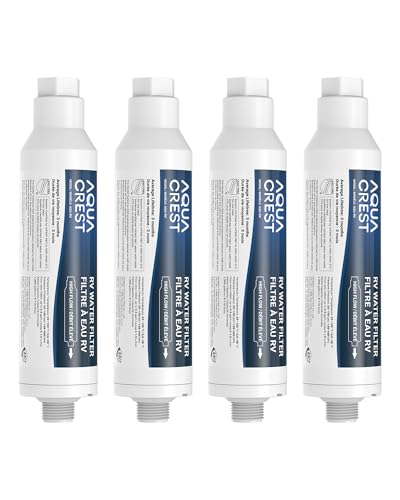
AQUA CREST RV Inline Water Filter for Garden Hose and Camper
★★★★★ 4.4 / 5 Best dual-purpose pick
Because it uses standard garden-hose threads, this Aqua Crest filter is happy on a camper inlet, an outdoor spigot for drinking water, or a pet and gardening hose, which makes it the pick if you want one filter to cover more than the RV. The carbon media works on chlorine taste, odor, and sediment just like the dedicated RV cartridges, so nothing is lost by choosing the more flexible fit. If the RV is your only use, a bundled hose-protector kit may serve you better, but for shared duty this is an easy call.
Threads Standard garden hoseUse RV, spigot, gardenMedia Activated carbonTargets Chlorine taste, odor, sediment
- Standard threads fit RV and garden hoses
- One filter covers several outdoor uses
- Carbon media handles the usual taste and sediment
- No hose protector in the box
- Single filter rather than a multipack
Best for: one filter for more than the RV
Advanced RV Inline Water Filter with Flexible Hose Protector, 2 Pack
★★★★★ 4.3 / 5 Best backup pair
This two-pack is the uncomplicated choice when you just want a working filter on the hose and a second one waiting in the storage bay, each with a flexible hose protector to save the fitting from a hard bend. The carbon media targets chlorine taste, odor, and sediment, the same job the pricier options do, so the appeal here is simply having a pair ready without overthinking the brand. Check the listed dimensions against your inlet clearance, as with any standard-body filter, before you head out.
Pack 2 filtersIncludes Flexible hose protectorMedia Activated carbonTargets Chlorine taste, odor, sediment
- Two filters cover a trip and a spare
- Hose protector eases the inlet bend
- Simple, no-fuss option to keep on hand
- Standard body flow, not high-flow
- Brand is less established than Camco
Best for: a simple pair to keep ready
The best RV inline water filter for most travelers is the Camco TastePURE XL, because its wide-body shell holds more carbon and keeps a strong flow while it cuts chlorine taste and odor and holds back sediment, and it includes a flexible hose protector for the inlet. If you want a third-party stamp, the Stokk two-pack lists NSF certification, and the RVGUARD four-pack is the value choice when you swap filters often. The standard Camco two-pack suits a tight inlet, the Glacier Fresh pair covers RV and marine use, the Aqua Crest filter fits a garden hose as well as a camper, and the Advanced two-pack is a simple backup pair. These are our chosen picks matched to how you travel, and it is worth remembering that an inline filter cleans up water you already trust as potable rather than purifying an unsafe source.
What an inline filter removes: taste, chlorine, and sediment
The job of an RV inline water filter is narrow and useful. Its granular activated carbon reduces the chlorine taste and odor that make campground water unpleasant to drink, and it holds back sediment, rust flecks, and grit that cloud the water and clog aerators. Filters using GAC and KDF media, like the Camco cartridges, add a step that also helps limit bacteria growth inside the housing between trips. What none of these do is purify or disinfect, since they are not built to remove viruses or reliably strip out harmful bacteria. That distinction matters: use an inline filter to polish water you already believe is safe, and rely on a dedicated purification method wherever the supply is genuinely in question. Understood for what it is, a good carbon filter is the cheapest upgrade to how your RV water tastes.
Single-stage versus dual-stage, and the micron rating
Every filter on this list is single-stage, meaning one carbon cartridge that handles taste, odor, and sediment in a single pass, which is enough for the great majority of campground hookups. A dual-stage system puts a separate sediment stage ahead of the carbon, and it earns its place only when you regularly draw from water with visible grit that would otherwise choke the carbon quickly. The micron rating is the other number worth a glance, and most RV inline filters sit around twenty microns. That figure is a deliberate balance, small enough to catch the sediment you care about, but open enough that water still flows fast enough to fill a tank without a trickle. Chasing a much lower micron number buys finer filtration at the cost of flow and filter life, so for typical use the standard rating is the sensible choice.
The flexible hose protector and how long a filter lasts
Several picks, including the Camco XL, the Stokk set, and the Advanced pair, ship with a flexible hose protector, and it is a small part that prevents a real problem. A rigid filter threaded straight onto a hose forces a sharp bend at the fitting, and that stress is exactly where kinks and cracks begin over a season. The protector lets the connection curve gently instead. On lifespan, treat these as single-season filters: makers generally rate them for around three months of typical use, and the real figure depends on how much water you run and how dirty it is. This is why the multipacks make sense, since a four-pack like the RVGUARD keeps the cost per filter low when you replace them often. When flow drops or the water tastes off again, fit a fresh cartridge rather than stretching a tired one.
Installing your filter and matching it to your setup
Installation takes a minute. Thread the filter onto your fresh-water hose, usually at the spigot end, add the hose protector if one came with it, and connect the hose to your RV city-water inlet. Run water through for a minute before filling to flush loose carbon fines and any taste from a new cartridge. Matching the filter to your setup is mostly about clearance and use: a wide-body filter like the Camco XL flows better but needs a little more room at the inlet, while a standard slim cartridge fits where space is tight. If you also boat, the Glacier Fresh pair is rated for marine use, and if you want one filter for the camper and the garden hose, the Aqua Crest uses standard threads. When you pack up, drain the filter, bag it, and keep it from freezing so the housing does not crack.
Questions people ask
What is the best RV inline water filter?
For most travelers our top pick is the Camco TastePURE XL, because its wide-body shell holds more carbon and keeps a strong flow while it cuts chlorine taste and odor and holds back sediment, and it ships with a flexible hose protector for the inlet. If a third-party stamp matters, the Stokk two-pack lists NSF certification, and if you want to keep the running cost down the RVGUARD four-pack is the value choice for frequent swaps. These are our chosen picks based on the media, the body size, and what each includes, not on any lab work of our own. Whichever you choose, remember an inline filter improves taste and clarity but is not a substitute for purification where the water is not known to be potable.
What does an RV inline water filter remove?
The carbon media in these filters is built to reduce chlorine taste and odor and to hold back sediment, rust flecks, and grit that make campground water taste and look off. Many, like the Camco cartridges, add KDF media that also helps limit bacteria growth inside the filter housing between uses. What they do not do is purify or disinfect water to make an unsafe source drinkable, since they are not designed to remove viruses or guarantee the removal of harmful bacteria. Use them to clean up water you already trust as potable, and rely on a proper purification method where the supply is uncertain.
Single-stage or dual-stage RV water filter?
A single-stage inline filter is one carbon cartridge and handles the common jobs of taste, odor, and sediment, which is enough for most campground hookups and is what every pick on this list is. A dual-stage setup adds a separate sediment stage ahead of the carbon, which helps a lot if you often draw from a supply with visible grit or fine particles that would otherwise clog the carbon quickly. For most part-time travelers a good single-stage filter is plenty; step up to dual-stage only if your usual water is noticeably dirty or if you are filling a tank you will drink from for weeks.
What micron rating do I need for an RV filter?
Most RV inline filters work in the range of about twenty microns, which catches sediment and grit while still letting water flow fast enough to fill a tank or run a faucet without a frustrating trickle. A lower micron number blocks smaller particles but flows slower and clogs sooner, while a higher number flows fast but lets more through. Twenty microns is the common balance you will see on these cartridges, and it is a sensible default for taste and clarity. If your water carries very fine sediment, a dedicated pre-filter ahead of the inline filter is the better fix than chasing a tiny micron rating.
Why do these filters come with a flexible hose protector?
The flexible hose protector is a short bendable sleeve that fits between the filter outlet and your hose, and it matters because a rigid filter connected straight to a hose puts a sharp strain on the threaded fitting. That strain is where kinks, cracks, and leaks tend to start over a season. The protector lets the connection curve gently instead of snapping to a hard angle, which protects both the filter housing and the hose end. Picks like the Camco XL, the Stokk set, and the Advanced two-pack include one, and it is worth adding if your chosen filter does not.
How long does an RV inline water filter last?
Treat these as single-season filters rather than long-life cartridges. Most makers rate them for roughly three months or a season of typical use, and the real life depends on how much water you run through and how dirty it is. A filter drawing clean municipal water at a few weekend trips will last longer than one fed silty water all summer. This is why the multipacks make sense, since a four-pack like the RVGUARD keeps the cost per filter low when you swap often. When flow drops noticeably or the water starts tasting off again, it is time for a fresh cartridge.
How do I install and store an RV inline filter?
Installation is simple, as you thread the filter onto your fresh-water hose, usually at the spigot end, add the flexible hose protector if it came with one, and connect the hose to your RV city-water inlet. Let it run for a minute before you fill to flush out loose carbon fines and any tase from a new cartridge. When you pack up, drain the filter and store it in a sealed bag so it does not dry out fully or pick up contamination, and in freezing conditions keep it from freezing, which can crack the housing. Note the install date so you know when the season is up.
How did we choose these RV inline water filters?
We looked at the reasons people actually shop for one, an everyday high-flow filter for regular hookups, a certified option, a value multipack for frequent swaps, the proven standard cartridge, an RV-and-marine pick, a dual-purpose garden-hose filter, and a simple backup pair, then chose a fitting product for each. Every filter shown is a real listing with genuine details from the maker, such as the media type, whether a hose protector is included, and the pack count. These are our chosen picks based on those details, and we always suggest confirming the size against your own inlet clearance before you buy.
The bottom lineSo which one?
The Camco TastePURE XL is our top choice for most travelers, since its wide body keeps flow up while the GAC and KDF media cut chlorine taste, odor, and sediment, and it comes with a hose protector for the inlet. Choose the Stokk set if NSF certification gives you confidence, the RVGUARD four-pack if you swap filters often and want the lowest cost per unit, and the standard Camco two-pack when inlet clearance is tight. The Glacier Fresh pair suits campers who also boat, the Aqua Crest fits a garden hose as well as the RV, and the Advanced two-pack is the simple backup. Match the filter to your clearance and how you travel, and confirm the size against your inlet before you buy. Remember these filters clean up water you already trust, not water from an unsafe source.