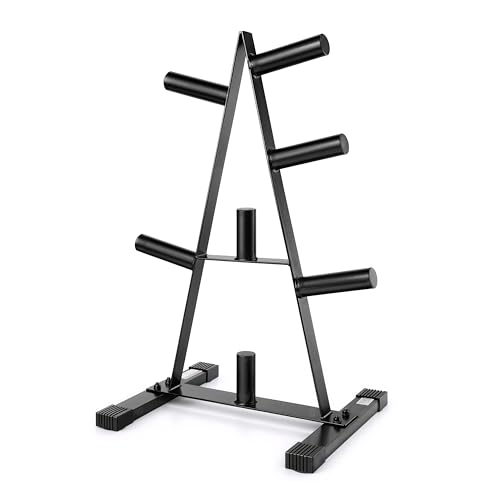
Weight Plate Storage
Best Weight Plate Storage Racks and Trees for Home Gyms
7 picks compared
9 min read
ProductPickly is reader-supported. When you buy through links on our site, we may earn an affiliate commission at no extra cost to you. It never changes our picks.
The short answerFor most home gyms the CAP Barbell Olympic 2-Inch Plate Rack is the weight plate storage to start with, a compact vertical tree that clears 2-inch Olympic plates off the floor onto a stable weighted base. If your collection has grown, the CAP bumper tree with barbell holders is rated to 440 pounds and stores your bars too, while the Amazon Basics tree is the simple value choice and the Josmimic tree holds a deeper stack on a slim base. Running 1-inch standard plates instead, the CZMIYRPY tree is one of the few sized to fit them. For a gym that stores dumbbells and kettlebells alongside plates, the Jusgym 3-tier rack takes it all, and the compact 2-tier stand suits a tight corner. Confirm the post size matches your plate hole before you buy, then pick by how much you store rather than by price alone.
?How we pickedWe compare published specifications, safety certifications and thousands of verified owner reviews, and we do not physically test every unit. Read the full process in our review methodology.
CAP Barbell Olympic 2-Inch Plate Rack
★★★★★ 4.7 / 5 Best overall
This is the vertical Olympic tree most home lifters end up buying: a weighted base with a set of angled posts sized for 2-inch plate holes, so bumper and iron plates slide on and stay put. CAP is a long-running budget-gym brand, which is why this is an easy first pick for anyone who wants a proven upright rack that clears plates off the floor without taking up a corner.
Style Vertical plate treeFits 2-inch Olympic platesBase Weighted floor standDetail Angled posts hold plates
- Small floor footprint for the number of plates it holds
- Angled posts keep plates from sliding off
- Established brand with wide availability
- Built for 2-inch holes, not standard 1-inch plates
- No wheels, so it stays where you set it
Best for: an Olympic home gym that wants a compact, proven upright tree
CAP Olympic Bumper Plate Tree with 2 Barbell Holders (440 lb)
★★★★★ 4.6 / 5 Best heavy-duty
This tree stores your bar and your plates in one place, with four Olympic posts rated to 440 pounds plus two upright holders for barbells. It is the pick for a setup that has grown past a handful of plates, since the heavier steel and the barbell slots keep a full loadout organized against a wall. If your gym runs bumpers and more than one bar, this carries the extra weight and clutter better than a light tree.
Style Vertical tree plus bar holdersFits 2-inch Olympic platesCapacity 440 lb ratedDetail 4 posts, 2 barbell slots
- Stores plates and two barbells in one unit
- Heavy steel handles a larger plate collection
- Higher rated capacity than basic trees
- Larger and heavier than a simple plate tree
- Only fits 2-inch Olympic plates
Best for: a growing gym that needs to store bumpers and more than one bar
Amazon Basics Olympic 2-Inch Weight Plate Tree Rack
★★★★★ 4.5 / 5 Best value
A plain, do-the-job Olympic tree that keeps plates off the floor and sorted by size on a small base. There is nothing fancy here, no wheels or bar holders, but the posts fit 2-inch plates and the footprint is tight, which is the whole point for a first storage rack. It is the pick for a starter home gym that wants a tidy upright without spending on extras it will not use yet.
Style Vertical plate treeFits 2-inch Olympic platesBase Compact floor baseDetail Sorts plates by size
- Simple upright that saves floor space
- Posts sized for standard 2-inch plates
- Easy to assemble for a first rack
- No wheels or barbell holders
- Lighter build than the heavy-duty trees
Best for: a starter Olympic setup that wants a tidy, no-frills tree
Josmimic Weight Plate Rack for 2-Inch Olympic Plates (400 lb)
★★★★★ 4.5 / 5 Best high-capacity tree
This upright tree pushes the rated capacity to 400 pounds while keeping to a single-column footprint, so it holds a deeper stack of Olympic plates than a basic starter rack. The posts are spaced to load largest to smallest, which keeps the base stable as it fills. It is the pick when you have more plates than a small tree can take but do not want the bulk of the full bar-and-plate units.
Style Vertical plate treeFits 2-inch Olympic platesCapacity 400 lb ratedDetail Graduated post spacing
- Holds a deeper plate stack than starter trees
- Single-column base keeps the footprint small
- Graduated posts load plates by size
- Only fits 2-inch Olympic plates
- No barbell storage built in
Best for: an Olympic gym that has outgrown a small tree but wants a slim base
CZMIYRPY Weight Tree for 1-Inch Standard Plates (300 lb)
★★★★★ 4.4 / 5 Best for standard plates
Most trees only fit 2-inch Olympic holes, so this one matters because its posts are sized for 1-inch standard plates, the kind that come with many entry-level dumbbell and barbell sets. It is a compact upright rated to 300 pounds that keeps a standard-plate collection off the floor. If your plates have the smaller center hole, this is the rack that actually fits rather than leaving plates loose against a wall.
Style Vertical plate treeFits 1-inch standard platesCapacity 300 lb ratedDetail Compact floor base
- Sized for 1-inch standard plate holes
- Compact upright for a small room
- Solid rated capacity for a standard set
- Will not hold 2-inch Olympic plates
- No wheels or bar storage
Best for: home gyms running 1-inch standard plates rather than Olympic
Jusgym 3-Tier Adjustable Weight Rack (1100 lb)
★★★★★ 4.5 / 5 Best for mixed gear
This is a horizontal shelved rack rather than a plate tree, with three adjustable tiers rated to 1100 pounds total for dumbbells, kettlebells, and stacked plates together. It is the pick for a gym that stores more than plates, since the open shelves take mixed gear that will not sit on a vertical post. If your floor is a jumble of dumbbells and plates, this pulls all of it onto one heavy-duty frame.
Style 3-tier horizontal rackFits Plates, dumbbells, kettlebellsCapacity 1100 lb ratedDetail Adjustable shelf tiers
- Holds mixed gear, not just plates
- Very high total rated capacity
- Adjustable tiers fit different equipment
- Larger footprint than a vertical tree
- Rack only, weights not included
Best for: a gym that needs to store plates alongside dumbbells and kettlebells
2-Tier Compact Weight and Plate Rack (350 lb)
★★★★★ 4.3 / 5 Best compact pick
A small two-tier stand rated to 350 pounds for a tight corner or a garage gym that only needs to tidy a modest set of plates and dumbbells. It is the pick when a full tree or a big shelved rack is more than you have room for, giving you two open levels to sort weights off the floor. Simple and low to the ground, it does the core job without dominating a small space.
Style 2-tier compact rackFits Plates and dumbbellsCapacity 350 lb ratedDetail Low, small footprint
- Small footprint for tight spaces
- Two open tiers sort plates and dumbbells
- Low profile is easy to slide into a corner
- Lower capacity than the larger racks
- Open shelves, not sized plate posts
Best for: a small corner or garage gym with a modest weight set
The fastest way to reclaim floor space in a home gym is to get plates off the ground and onto a rack that fits their center hole. The picks below split across the shapes that actually matter: vertical plate trees that store the most in the smallest footprint, heavier steel units that hold bars and plates together, standard-fit trees for 1-inch plates, and shelved racks for mixed gear. Match one to the plates you own, and check the post size before you buy.
Vertical plate tree vs horizontal rack vs wall-mount
Almost every storage option falls into one of three shapes. A vertical plate tree, like the CAP or Amazon Basics picks, uses angled posts on a weighted base so plates hang by their hole and stack upward, which stores the most plates in the least floor space. A horizontal rack, like the Jusgym 3-tier stand, trades footprint for flexibility, using open shelves that take dumbbells and kettlebells alongside plates. Wall-mounted plate holders bolt into studs to keep the floor completely clear, but they depend on solid wall anchors and a stud you can hit, so they suit finished rooms more than a bare garage. For most people a vertical tree is the simplest win; choose a shelved rack when you store more than plates, and a wall mount only when the wall can safely carry the load.
Olympic vs standard plate fit
The single detail that decides whether a rack works for you is the post size, and it is where buyers go wrong most often. Olympic plates have a 2-inch center hole and standard plates have a 1-inch hole, and the two are not interchangeable on a rack. The CAP, Amazon Basics, and Josmimic trees here are all built for 2-inch Olympic plates, while the CZMIYRPY tree is one of the few sized for 1-inch standard plates. Before buying, look at your own plates and confirm the hole size, because a 2-inch post will leave standard plates rattling loose and a 1-inch post will not accept an Olympic plate at all. Bumper plates share the 2-inch Olympic hole, so they fit the Olympic trees, though their larger diameter means fewer per post.
Weight capacity, stability, and wheels
Rated capacity ranges widely here, from 300 pounds on the standard tree to 1100 on the shelved rack, and the number that matters is not the maximum but how much headroom you leave. A tree loaded to its limit is less stable than the same tree half full, so size up if you own a lot of plates. Stability comes from the base: a wide, weighted base keeps a loaded vertical tree from tipping when you pull a heavy plate off one side. Most trees in this guide are fixed stands without wheels, which is fine for a rack that stays put; if you need to move a loaded rack, look specifically for locking casters, since an unlocked wheel under hundreds of pounds is a hazard on any slope.
Saving floor space in a small gym
If space is the whole reason you are shopping, a vertical plate tree gives you the most storage per square foot, because plates rise up the posts instead of sprawling across the floor. The Josmimic tree packs a deep stack onto a single-column base, and the compact 2-tier stand slides into a corner a full rack could not. Leaning plates against a wall feels free but wastes space and risks a plate sliding flat onto a foot, so even a basic tree pays for itself in a tidy, safer room. Put the rack where you rack plates after a set, load largest to smallest to keep the base steady, and you turn a cluttered corner into usable floor without changing anything else about the gym.
Questions people ask
What is the difference between a vertical plate tree and a horizontal rack?
A vertical plate tree has angled posts on a small base, so plates slide onto the posts and hang by their center hole. It takes very little floor space and keeps plates sorted by size, which suits a gym that mostly stores plates. A horizontal rack, like the 3-tier stand, uses open shelves instead of posts, so it holds mixed gear such as dumbbells and kettlebells alongside stacked plates. Trees win on footprint; shelved racks win when you store more than plates.
Do these racks fit both Olympic and standard plates?
Not interchangeably. Most trees here are built for 2-inch Olympic plate holes, so the CAP, Amazon Basics, and Josmimic posts will only take 2-inch plates. If your plates have the smaller 1-inch center hole, which is common on entry-level sets, you need a standard-fit rack like the CZMIYRPY tree. Always confirm the post size matches your plate hole before buying, because a 2-inch post will not hold a 1-inch plate securely and a 1-inch post will not fit an Olympic plate at all.
How much weight can a plate storage rack hold?
It varies by design. The compact 2-tier stand is rated to 350 pounds, the standard CZMIYRPY tree to 300, the Josmimic and CAP Olympic trees to around 400 to 440 pounds, and the 3-tier shelved rack up to 1100 pounds total. Treat these as maximums and leave headroom rather than loading to the limit. If you own a lot of plates, or plan to add more, size up so the base stays stable and you are not spreading weight across two racks later.
Do weight plate racks come with wheels?
Most vertical plate trees, including the CAP, Amazon Basics, and standard-plate picks here, are fixed floor stands without wheels, since the weighted base is what keeps them stable when loaded. That is fine for a rack that lives in one spot. If you want to roll a loaded rack across a garage, look specifically for a model that lists caster wheels, and check whether they lock, because an unlocked wheel under a few hundred pounds of plates is not something you want drifting on a slope.
How much floor space does a plate tree save?
A vertical tree stores a stack of plates in roughly the footprint of a single large plate laid flat, because the plates go up the posts rather than out across the floor. That is the main reason to buy one over leaning plates against a wall, where they sprawl and can topple. A shelved rack takes more floor but stores mixed gear. If space is your main problem, a vertical tree gives you the most storage per square foot of any option here.
Are heavier steel racks worth it over basic trees?
It depends on how many plates you own. A basic tree like the Amazon Basics pick is enough for a starter set and costs less to get you organized. A heavier unit like the CAP bumper tree with barbell holders earns its extra bulk once you have a full plate collection and more than one bar, because it carries more weight and stores the bars too. Buy for the gym you have now with a little room to grow, not for a gym twice its current size.
Can I store bumper plates on these racks?
Yes, on the Olympic trees. Bumper plates use the same 2-inch center hole as iron Olympic plates, so they load onto the CAP, Amazon Basics, and Josmimic posts the same way. The CAP tree with a 440-pound rating and barbell holders is built with bumpers in mind. Bumpers are wider than iron plates, so you may fit fewer per post before they crowd, and their larger diameter is worth keeping in mind when you judge how full a tree will look.
How did we choose the racks in this guide?
We looked at plate fit, whether a rack takes 2-inch Olympic or 1-inch standard plates, then at rated capacity, footprint, build, and whether it stores anything beyond plates such as bars or dumbbells. We then matched each one to a clear use, from a compact starter tree to a heavy-duty bar-and-plate unit to a mixed-gear shelved rack. Every product shown is a real listing, and these are our chosen picks rather than lab-tested claims, so confirm the post size fits your own plates before you buy.
The bottom lineSo which one?
The CAP Barbell Olympic 2-Inch Plate Rack is our top choice for most home gyms, a compact vertical tree that stores 2-inch Olympic plates on a stable base without eating floor space. When your collection outgrows a starter tree, the CAP bumper tree with barbell holders carries more weight and stores your bars, the Josmimic tree holds a deeper stack on a slim base, and the Amazon Basics tree covers a simple value start. Choose the CZMIYRPY tree if your plates use the 1-inch standard hole, the Jusgym 3-tier rack when you store dumbbells and kettlebells alongside plates, and the compact 2-tier stand for a tight corner. Match the rack to your plate size and how much you store, and it will keep the gym floor clear for years.