Overview
This is an editorial, listing-based review of the Astercook deep-carbonized bamboo cutting boards set. I have not used these boards, so nothing here is a hands-on account. Instead, this walks through what the Amazon listing describes, what deep-carbonized bamboo generally means for a kitchen board, and the honest tradeoffs you take on with any wood or bamboo surface. The goal is to help you decide whether this set fits the way you actually cook, rather than to tell you it passed any kind of trial it never went through.
On paper, Astercook frames this as a practical everyday set: a group of reversible bamboo boards in graduated sizes, finished with a deep-carbonization process that darkens the wood, paired with a wood storage stand, juice grooves, and easy-grip handles. The listing even leans into gifting, describing it as a Father's Day gift idea. Below I separate the marketing from the parts that genuinely matter when you are chopping onions on a Tuesday night.
What it is
The Astercook product is a set of deep-carbonized bamboo cutting boards built for general kitchen use. The listing presents it as multiple boards in different sizes so you can reach for a small board for a lemon or a herb and a larger board for breaking down vegetables or plating a spread. Because it is bamboo rather than a single hardwood slab, the boards are relatively light for their footprint and are meant to be handled, carried, and stored upright in the included wood stand.
Two listing details shape the whole product. First, the boards are reversible, so each one gives you two working faces, which is handy if you want to keep one side for produce and the other for cooked or ready-to-eat foods. Second, the deep-carbonization is the headline finish. Carbonizing bamboo under heat is what gives these boards their darker, toasted color and is marketed as a way to make the surface denser and more resistant to moisture than raw, pale bamboo. The exact number of boards and their dimensions are the kind of spec that listings update over time, so confirm the current count and sizes on the product page before buying.
Key features per listing
Here is how the manufacturer describes the set. Everything in this section is a listing claim, not something I verified in a kitchen.
- Graduated board set: several bamboo boards in different sizes, intended so you can match the board to the job and keep foods separated by size.
- Deep-carbonized bamboo: a heat treatment that darkens the bamboo and is marketed for added durability and moisture resistance compared with untreated bamboo.
- Reversible faces: each board works on both sides, which doubles your usable surface and lets you dedicate sides to different food groups.
- Juice grooves: a recessed channel around the working surface that is designed to catch runoff from juicy produce or carved meats instead of letting it spill onto the counter.
- Easy-grip handles: cutout handle holes that make the boards simpler to lift, carry to the table, and hang or store.
- Wood storage stand: an included rack so the boards can sit upright between uses, which also helps them dry and keeps the set tidy on a counter.
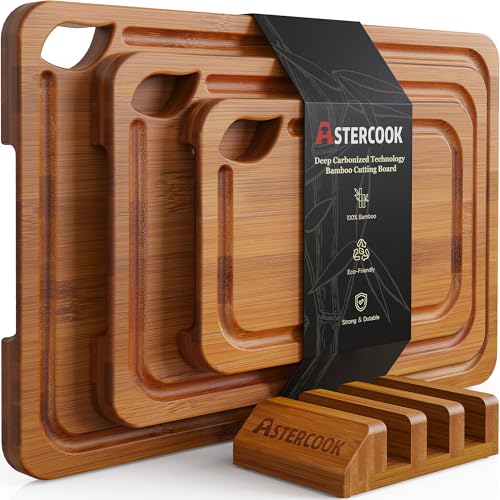
Astercook Deep-Carbonized Bamboo Cutting Boards
A reversible deep-carbonized bamboo set with juice grooves, grip handles, and a wood storage stand, per the listing.
Check price on AmazonWho it is for
Based on the listing, this set makes the most sense for a few specific cooks. If you do everyday chopping and want more than one board so you are not constantly washing a single surface mid-recipe, the graduated sizes are the main draw. The size range also suits anyone who likes to separate foods by board, for example keeping a smaller board for fruit and a larger one for vegetables or for a cheese and charcuterie spread.
It is also a natural pick if you simply prefer wood and bamboo over plastic. Some cooks like the feel and the quieter cutting surface of bamboo, and they are comfortable with the extra care that wood needs. The included stand and the gift framing make it reasonable as a present for someone setting up a kitchen or upgrading from a worn plastic board. If, on the other hand, you want a board you can toss in the dishwasher and forget about, this is not that product, and I cover why in the next sections.
Strengths on paper
Several of the listing's claims line up with the general, well-understood advantages of bamboo boards, so they are fair to credit even without hands-on use.
Bamboo and wood surfaces are generally gentler on knife edges than steel, glass, or stone boards. Hard surfaces can roll or dull an edge quickly, while a bamboo board has enough give to be kinder to your knives, even though it is firmer than softwood. Bamboo is also a fast-growing, renewable grass, so it tends to be an easier material to feel good about than plastic from a sustainability standpoint. The juice grooves are a genuinely useful design feature when you are slicing tomatoes, melon, or anything carved, since the channel gives runoff somewhere to go instead of your countertop. The reversible faces and the graduated sizes add real flexibility, and the storage stand addresses a practical problem, which is where a multi-board set actually lives when you are not using it. Taken together, these are sensible, functional strengths rather than gimmicks.
Things to check honestly
Bamboo asks for more care than plastic, and it is only fair to be upfront about that. None of this is a knock specific to Astercook. It is the honest reality of owning any bamboo or wood board.
These boards should be hand-washed, not put in the dishwasher. Dishwasher heat and prolonged water exposure are hard on bamboo and can lead to warping, splitting, or cracking over time. For the same reason, you should not let a board soak, and you should dry it promptly, ideally standing it upright in the included stand so air reaches both faces. Bamboo also benefits from being oiled periodically with a food-safe mineral or board oil to keep it from drying out and cracking, so factor that small, occasional chore into your decision.
There is also a knife-edge nuance. While bamboo is gentler than steel or glass, it is harder and denser than many softer hardwoods, so over a long time it can dull knives slightly more than a plush end-grain block would. That is a tradeoff, not a dealbreaker, and regular honing offsets it. Finally, confirm the exact board count, dimensions, and whether the stand suits your counter space on the current listing, since those details can change and I am working from the listing rather than a ruler.
How it compares
It helps to place bamboo against the two alternatives most shoppers weigh. Plastic boards are the cheapest and the most carefree, since they are dishwasher safe and easy to replace, but they scar with deep knife grooves that can trap residue, and many cooks find them harder on edges and less pleasant to use than wood. Bamboo, like this Astercook set, sits in the middle: it is kinder to knives than plastic, it looks and feels more premium, and it is renewable, but it demands hand-washing and occasional oiling in return.
At the top sits end-grain hardwood, the thick butcher-block style board. End-grain wood is the gentlest on knife edges and the most forgiving surface because the fibers stand upright, but those boards are heavy, bulky, usually far more expensive, and they need the same, or more, maintenance than bamboo. Against that spread, a reversible bamboo set like this one is a reasonable middle path for an everyday kitchen: lighter and easier to store than end-grain blocks, more durable and edge-friendly than plastic, and finished with grooves and handles that add practical convenience. If you want zero maintenance, plastic wins; if you want the absolute best cutting feel and have the budget and the counter space, end-grain wins; for most home cooks who want a capable, good-looking set and accept light care, bamboo is the sensible compromise.
Verdict
On the strength of the listing, the Astercook deep-carbonized bamboo cutting boards look like a sensible, flexible set for everyday chopping and serving. The graduated sizes, reversible faces, juice grooves, grip handles, and storage stand all address real kitchen needs, and the deep-carbonized finish is marketed for durability and a darker look. The honest caveats are the ones that come with all bamboo: hand-wash only, keep it out of the dishwasher, dry it upright, and oil it now and then to prevent cracking. If you are comfortable with that small care routine and you prefer wood over plastic, this set is worth a close look. If you want a zero-maintenance board, plastic will suit you better. To check the current configuration, sizes, and details for yourself, see the Astercook bamboo boards on Amazon.
Disclosure: This is an editorial, spec-based review built from the product's Amazon listing and general knowledge of bamboo boards, not from hands-on use. As an Amazon Associate, we may earn from qualifying purchases made through links on this page at no extra cost to you.