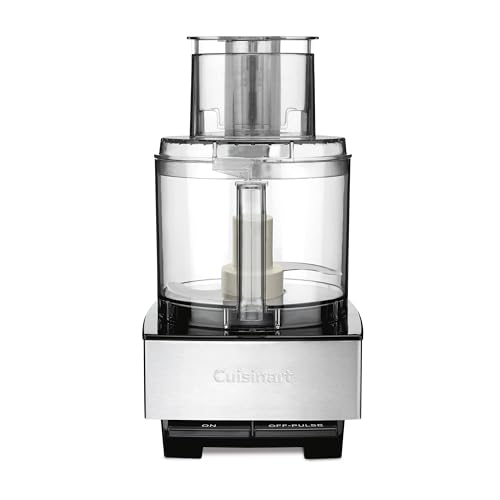
If you want a food processor that genuinely earns its counter space for daily cooking, our pick for most people is the BLACK+DECKER 8-cup. It gives you the bowl capacity and the slicing, shredding, and chopping attachments that real meal prep needs, so it moves from onions and cheese to doughs and purees without slowing you down. If your cooking is mostly small jobs, chopping herbs, nuts, garlic, or a quick dressing, a 3-cup mini such as the Cuisinart is the smarter and more compact choice. Below we explain when each one is right and what actually matters once you use a processor every day.
Our top pick for everyday cooking
For someone who genuinely cooks every day, capacity and attachments decide how useful a food processor really is, and that is why the BLACK+DECKER 8-cup is our pick for most kitchens. An eight cup bowl is large enough to chop a full onion, shred a block of cheese, or blitz a batch of soup base in one go, so you are not stopping to empty a tiny bowl every thirty seconds. The included attachments shred, slice, mince, grind, and puree, which means the jobs people actually repeat at home, slaw, grated cheese, even sliced potatoes for a gratin, are all covered by one machine. The 450 watt motor is sized for that kind of regular work rather than occasional use. It takes more room on the counter and more time to wash than a mini, but if daily cooking is the goal, that trade is usually worth making.

BLACK+DECKER 8-Cup Food Processor
Eight cup bowl, 450 watt motor, and attachments to shred, slice, mince, grind, and puree, so it handles most daily prep in one machine.
Check price on AmazonWhen a mini food processor makes more sense
Not everyone needs a full size bowl, and a mini can be the better daily tool if your prep is small and frequent. the Cuisinart 3-cup mini earns its keep here. Its three cup bowl and reversible blade handle chopping on one side and a finer grind on the other, which covers herbs, nuts, garlic, parmesan, and quick sauces or dressings with very little fuss. It is light, quick to rinse, and small enough to leave out or tuck into a cupboard, so you actually reach for it instead of leaving a big machine idle.
If you want the simplest possible daily chopper, the Hamilton Beach 3-cup chopper is worth a look. It is a straightforward three cup vegetable chopper and mini processor built for the common jobs, onions, peppers, and other vegetables that you would otherwise dice by hand. It does not try to slice or shred like the full size BLACK+DECKER, and that focus is the point. For a smaller kitchen or someone who only wants to stop the tears and speed up chopping, it is an easy, compact option.
What actually matters when you cook every day
Once a processor is in regular use, a few things matter far more than the spec sheet suggests, and a few matter less than the marketing implies.
Bowl capacity is the first real decision. A three cup mini is perfect for small batches but frustrating if you cook for a family, while an eight cup bowl like the BLACK+DECKER lets you prep a whole meal worth of vegetables without stopping. Match the size to how much you actually cook, not to the biggest number.
Motor power matters most when you push a machine with harder jobs, firm vegetables, nut butters, or stiff dough. A mini is happy with soft, light work. The 450 watt BLACK+DECKER is built for heavier, repeated tasks. If you only ever chop herbs, a strong motor is not something you will notice.
Blade and disc attachments are what turn a chopper into a true food processor. A single chopping blade, as on both minis, covers chopping and pureeing. Slicing and shredding discs, as included with the BLACK+DECKER, are what let you grate cheese or slice vegetables evenly, and those are the daily jobs that save the most time.
Ease of cleaning quietly decides whether you keep using the machine. Fewer parts and a simple bowl, which is where the minis win, means you rinse and move on. A full size processor with discs has more to wash, so if cleanup time is your limit, lean smaller.
Footprint is the last honest factor. A mini stores in a drawer or cupboard. A full size machine wants a permanent spot on the counter, because if you have to lift it out of a low cabinet every time, you will stop using it.
What to ignore: a long list of attachments you will never fit into your routine, and any claim that one machine does everything perfectly. Pick for the jobs you repeat, not for the ones you might try once.
How these three compare
The gap between these three is really a gap in size and ambition, not quality. The two minis, the Cuisinart and the Hamilton Beach, overlap closely. Both are three cup machines aimed at chopping small amounts. The Cuisinart reversible blade gives it a little more range, chop on one side and a finer grind on the other, which makes it the more flexible mini for sauces and nuts. The Hamilton Beach keeps things simple and is squarely a quick vegetable chopper, which is exactly what some cooks want.
The BLACK+DECKER sits in a different class. With its eight cup bowl, 450 watt motor, and slice, shred, mince, grind, and puree attachments, it is the only one of the three that replaces several hand tasks at once. If you compared them purely on daily cooking versatility, the BLACK+DECKER wins. If you compared them on speed, simplicity, and storage for small jobs, a mini wins. Neither is wrong, they just answer different kitchens.
The honest verdict
For most people who cook daily and want one machine that genuinely pulls its weight, we would choose the BLACK+DECKER 8-cup. Its capacity and attachments cover the repeat jobs that eat up prep time, and that is where a processor pays you back. If your cooking leans small and frequent, the Cuisinart 3-cup is the mini we would reach for first, with the Hamilton Beach as the simpler, more focused chopper.
Whichever way you lean, buy for the cooking you actually do. A big machine you dread cleaning will sit unused, and a tiny bowl will frustrate you if you cook for a crowd. For more options in this category, see our full food processors guide. And if daily cooking for you also means batch prep and leftovers, our guides to food dehydrators and food storage containers pair naturally with a good processor.