Portable Power Stations
Best Portable Power Stations
7 picks compared
8 min read
ProductPickly is reader-supported. When you buy through links on our site, we may earn an affiliate commission at no extra cost to you. It never changes our picks.
The short answerFor most people the BLUETTI AC180 is the best portable power station overall, because its 1152Wh LiFePO4 battery and 1800W output cover both a home backup and a camp where smaller units fall short on capacity or power. The BLUETTI AC70 at 768Wh and 1000W is the balanced midsize choice, and the STARYLINE is the large capacity alternative at 1024Wh. For compact use the 256Wh ALLWEI and the 296Wh EnginStar with its pure sine outlets are the picks, the 192Wh DaranEner is the budget option, and the 120W HOWEASY is the lightest for phones and low draw gear.
?How we pickedWe compare published specifications, safety certifications and thousands of verified owner reviews, and we do not physically test every unit. Read the full process in our review methodology.
BLUETTI AC180 Portable Power Station, 1152Wh, 1800W, LiFePO4
★★★★★ 4.6 / 5 Best overall
The AC180 is the biggest station in this list, with a 1152Wh LiFePO4 battery and 1800W of rated AC output, which is why it reads as the do everything pick for both a camp and a home backup. The combination of a large capacity pack and a high output inverter means it is the one here sized for larger loads rather than just phones and lights.
- Largest 1152Wh capacity in this list
- High 1800W AC output for bigger loads
- LiFePO4 chemistry is the long life type
- The large pack is the heaviest to carry
- Port count and recharge times are not stated in the listing
Best for: A large capacity station for home backup and longer trips
STARYLINE Portable Power Station, 1024Wh, 1000W, LiFePO4
★★★★★ 4.4 / 5 Large capacity pick
STARYLINE pairs a 1024Wh LiFePO4 battery with a 1000W inverter, which puts it just below the AC180 on capacity while still clearing the kilowatt mark on output. The listing points it at both outdoor and home use, so it is a sensible large capacity alternative if you want four figures of watt hours without the very top of the range.
- Four figure 1024Wh capacity
- 1000W output handles many midsize loads
- LiFePO4 chemistry for a long cycle life
- Solar input is not confirmed in the listing
- Port layout and recharge times are not stated
Best for: A large LiFePO4 station for home and outdoor backup
BLUETTI AC70 Portable Power Station, 768Wh, 1000W, LFP
★★★★★ 4.5 / 5 Best midsize
The AC70 sits in the useful middle of the range with a 768Wh LFP battery and a 1000W inverter, so it keeps the kilowatt output of the bigger units in a smaller pack. LFP is the same long life lithium iron phosphate chemistry written another way, and the listing is a solar generator, which makes this the balanced midsize choice.
- 1000W output in a midsize 768Wh body
- LFP chemistry is the long life type
- Smaller and lighter than the four figure packs
- Less capacity than the 1024Wh and 1152Wh units
- Exact port count is not stated in the listing
Best for: A balanced midsize station for weekends and light backup
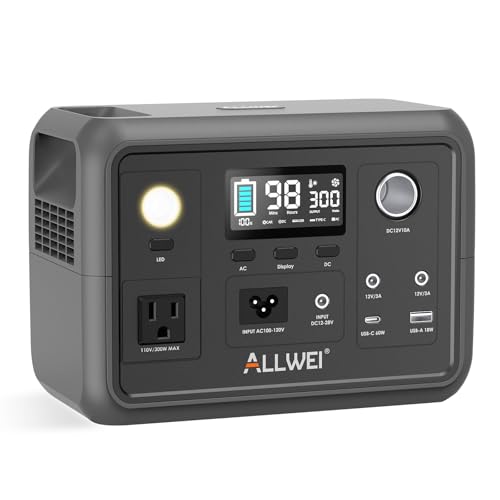
ALLWEI Portable Power Station, 256Wh, 300W, LiFePO4
★★★★★ 4.3 / 5 Compact LiFePO4
ALLWEI brings the long life LiFePO4 chemistry down into a compact 256Wh, 300W body, which is the smaller end of what still runs an AC outlet. It is a sensible choice if you want the durable battery type the big units use but in a station that is easy to carry for camping and small device backup.
- LiFePO4 chemistry in a compact body
- Light enough to carry for camping
- Solar input for off grid recharging
- 256Wh and 300W suit small loads only
- Port count and weight are not stated in the listing
Best for: A compact LiFePO4 station for camping and small devices
EnginStar Portable Power Station, 296Wh, 300W, Pure Sine Wave AC
★★★★★ 4.4 / 5 Compact with pure sine
This EnginStar unit lists a 296Wh lithium battery and two 110V pure sine wave AC outlets rated at 300W, with an 80000mAh pack quoted in the title. Pure sine wave output is the clean waveform you want for sensitive electronics, which makes this compact station a good match for a road trip, an RV or a short blackout.
- Two pure sine wave AC outlets
- Clean output suits sensitive electronics
- Compact size for a car, RV or trip
- 296Wh and 300W suit small loads only
- Battery chemistry is not specified as LiFePO4
Best for: A compact pure sine station for road trips and blackouts
DaranEner Portable Power Station, 192Wh, 300W, LiFePO4
★★★★★ 4.3 / 5 Budget pick
The DaranEner is the smallest capacity station here at 192Wh, with a 300W rated output that surges to 600W, a 110V AC outlet and the long life LiFePO4 chemistry. The listing notes a solar generator option, so it is the entry point in this group for keeping phones, lights and small electronics going on a trip or in an emergency.
- LiFePO4 chemistry in the smallest body
- 300W rated with a 600W surge headroom
- Easiest in this group to carry and store
- 192Wh is the least capacity in this list
- Suited to small devices, not large loads
Best for: A light, low capacity station for phones, lights and small gear
HOWEASY Portable Power Station, 120W, 240W Peak, Solar Generator
★★★★★ 4.2 / 5 Lightest pick
The HOWEASY is the lowest output unit here, rated at 120W with a 240W peak and listed as a solar generator, which places it between a large power bank and a small station. The listing does not state a watt hour capacity, so we have left that figure out, but as the smallest option it is built for phones, cameras and other low draw gear.
- Lowest output and smallest footprint here
- Solar input for topping up off grid
- Easy to pack for low draw devices
- 120W output is the lowest in this list
- Capacity and chemistry are not stated in the listing
Best for: The lightest option for phones, cameras and low draw gear
A portable power station is a battery in a box with AC and USB outlets, and the right one depends on how much energy you need to store and how much power you need to pull at once. The picks below are drawn from current Amazon listings and span a stated 120W all the way to a 1152Wh, 1800W unit, chosen for capacity, output, battery chemistry and solar input. We only quote a spec where the listing states it, so you can match a station to your use honestly rather than to a marketing headline.
Sizing by watt hours
The first number to read is watt hours, or Wh, which is how much energy the battery holds and therefore how long it can run a given load. In this list that ranges from a stated 192Wh on the DaranEner, through 256Wh and 296Wh on the compact ALLWEI and EnginStar, up to 768Wh on the BLUETTI AC70, 1024Wh on the STARYLINE and 1152Wh on the BLUETTI AC180, roughly a six fold spread from the smallest to the largest. More watt hours mean longer running or more devices, but also more weight and bulk, so size the capacity to the job rather than buying the biggest pack by default. The HOWEASY does not state a watt hour figure, so we have left that out rather than guess at it.
Output watts and what it runs
Capacity decides how long, but the output in watts decides what you can plug in at all. The BLUETTI AC180 is rated at 1800W and the AC70 and STARYLINE at 1000W, which is the territory for larger draws, while the ALLWEI, EnginStar and DaranEner are 300W units and the HOWEASY is 120W with a 240W peak, aimed at phones, lights, cameras and similar low draw gear. A surge rating, such as the DaranEner 600W surge, is the brief extra a station can supply when a device first switches on. The honest way to choose is to add up the wattage of what you want to run at once and keep it under the rated output, rather than trusting a device count. We do not promise a runtime for any specific appliance, because the listings do not state one.
LiFePO4 versus other battery chemistry
Battery chemistry is the quiet spec that affects how long a station lasts over the years. Most units here list LiFePO4, also written LFP for lithium iron phosphate, which is valued for a long cycle life and stable behaviour: the BLUETTI AC180, STARYLINE, BLUETTI AC70, ALLWEI and DaranEner all state it. The EnginStar lists a lithium battery but does not name it as LiFePO4, and the HOWEASY does not state its chemistry at all, so we have flagged both rather than assume. If you expect to cycle the station often, the LiFePO4 units are the ones to favour, and where a listing stays vague we have left the claim out instead of filling it in.
Solar input, recharging and camping versus backup
How you recharge, and where you use the station, round out the choice. Several of these are sold as solar generators, meaning they accept solar input: the BLUETTI AC180, BLUETTI AC70, ALLWEI and HOWEASY, with the DaranEner listing a solar generator option, though panels are generally sold separately. The STARYLINE listing does not confirm solar input, so check that before you rely on it off grid. For camping, a compact 192Wh to 296Wh unit is easy to carry for phones, lights and small electronics. For a home backup you usually want the stored energy and output of the 768Wh AC70, the 1024Wh STARYLINE or the 1152Wh, 1800W AC180. Decide where it will mostly live, and the capacity and recharge options tend to settle the rest.
Questions people ask
Which portable power station is best for most people?
For most people the BLUETTI AC180 is the strongest all round pick, because its 1152Wh LiFePO4 battery and 1800W output cover both a camp and a home backup where smaller units run out of either capacity or power. If that is more than you need, the BLUETTI AC70 at 768Wh and 1000W is the balanced midsize step down, and the compact 256Wh ALLWEI or 192Wh DaranEner cover phones, lights and small electronics.
What does watt hours, or Wh, actually mean?
Watt hours measure how much energy the battery holds, so a larger number means the station can run a given load for longer before it is empty. In this list that spans a stated 192Wh on the DaranEner up to 1152Wh on the BLUETTI AC180, roughly a six fold difference in stored energy. We only quote the figure where the listing states it, which is why the HOWEASY is marked as capacity not stated.
What does the output in watts tell me?
The output in watts is the most a station can power at one instant, so it decides what you can plug in rather than for how long. The 1800W BLUETTI AC180 and the 1000W AC70 and STARYLINE are rated for larger draws, while the 300W compact units and the 120W HOWEASY are meant for phones, lights, cameras and other low draw devices. Check both the rated output and any surge figure against what you plan to run.
What is LiFePO4 and why does it matter?
LiFePO4, also written LFP, is lithium iron phosphate, a battery chemistry known for a long cycle life and stable behaviour, which is why so many stations advertise it. The BLUETTI AC180, STARYLINE, BLUETTI AC70, ALLWEI and DaranEner all list it. The EnginStar lists a lithium battery without naming it as LiFePO4, and the HOWEASY does not state its chemistry, so we have said so rather than assume.
Can these power stations recharge from solar panels?
Several here are sold as solar generators, which means they accept solar input, including the BLUETTI AC180, BLUETTI AC70, ALLWEI and HOWEASY, while the DaranEner lists a solar generator option. Solar panels are usually sold separately unless the listing says otherwise. The STARYLINE listing in this group does not confirm solar input, so if off grid recharging matters, check the panel compatibility before you buy.
What is a pure sine wave output and do I need it?
A pure sine wave inverter produces the smooth power shape that mains electricity uses, which is gentler on sensitive electronics than a modified wave. In this list the EnginStar specifically lists two 110V pure sine wave AC outlets. If you plan to run laptops, cameras or medical style devices, a pure sine output is worth looking for, and many stations now use it even where the listing does not spell it out.
How do I pick a size for camping versus home backup?
For camping, weight and bulk matter most, so a compact unit such as the 256Wh ALLWEI, 192Wh DaranEner or the light HOWEASY is easy to carry for phones, lights and small gear. For home backup you usually want more stored energy and higher output, which points to the 768Wh BLUETTI AC70, the 1024Wh STARYLINE or the 1152Wh, 1800W BLUETTI AC180. Match the capacity to how long you need to run things.
Will a power station run a fridge, a kettle or power tools?
That depends on the appliance's wattage against the station's rated and surge output, and we will not promise a specific runtime the listings do not state. As a guide, high draw items like kettles, many fridges and power tools need the higher output units such as the 1800W BLUETTI AC180, while 300W and 120W stations are meant for low draw electronics. Always check the appliance label against the station's rated watts first.
The bottom lineSo which one?
Our top pick is the BLUETTI AC180, because a 1152Wh LiFePO4 pack with 1800W of output covers more situations than anything else here, from home backup to a longer trip. Step down to the BLUETTI AC70 or the STARYLINE when you want a large station without the very top of the range, and choose the compact ALLWEI, EnginStar or the budget DaranEner when portability matters more than capacity. The HOWEASY is the lightest for low draw gear. Choose by the watt hours you need, the output your devices demand, and whether solar recharging and LiFePO4 chemistry matter for how you will use it.