
If you want a compact welder that can stick weld off a standard 120V household outlet, our pick is the YESWELDER 135A 3-in-1. It runs on 110V, switches between flux-core MIG, stick (MMA), and lift TIG, and its output range suits thin to medium steel without a 240V hookup. We would choose it when you want one small machine for general repairs and light fabrication on a normal circuit. Step up to the dual-voltage HITBOX if you expect to wire a 240V outlet later, or the 7.5 lb Futelo if raw portability matters most.
The short answer
The question is a common one: a small welder, able to run stick rod, that plugs into a regular wall outlet, without a huge outlay. All three machines here are 110V 3-in-1 units, so every one of them can stick weld, run self-shielded flux-core wire, and do lift-start TIG. That makes the real decision less about "stick versus MIG" and more about power headroom, weight, and whether you ever plan to move up to 240V.
For most people in this spot, the YESWELDER 135A stands out as the balanced choice. It is a proven 110V design, it covers all three processes, and its listed output lands in a sensible range for a single household circuit. One honest caveat up front: welders pull serious current. These run on 120V, and a dedicated 20A circuit is the safer home for them. A 15A circuit can work for lower amperage settings and thinner steel, but pushing the output high can trip a 15A breaker. That is physics, not a fault of any one machine. Check your breaker and outlet before you buy.
When each welder is the right call
The three units overlap a lot, so the differences that matter are power, weight, and voltage flexibility.
Our pick for a standard circuit: YESWELDER 135A. A 110V-only 3-in-1 whose listed output tops out around 135 amps. That is enough for repairs, brackets, trailers, and light fabrication in steel, and it keeps you on a single wall outlet. If you want one machine that does the job without fuss, this is the one we would reach for.

YESWELDER 135A MIG Welder, 110V Flux Core Gasless MIG/Lift TIG/Stick 3-in-1
110V 3-in-1 (flux-core MIG, stick, lift TIG). A sensible all-rounder that runs on a standard household circuit.
Check price on AmazonIf you may upgrade to 240V: HITBOX 200A. This one is dual voltage, 110V or 220V. Its headline 200 amp number is a 220V figure, so on a 120V circuit you should expect meaningfully less output, which is normal for dual-voltage machines. The appeal is future room: plug it into a normal outlet now, and if you ever wire a 240V plug, you unlock the higher end for thicker steel.

HITBOX 200A MIG Welder, 110V/220V Flux Core MIG/Lift TIG/Stick 3-in-1
Dual-voltage 3-in-1. Runs on 120V today, with headroom on 240V later. The 200A rating is a 220V number.
Check price on AmazonIf portability is everything: Futelo 145A. At a listed 7.5 lb, this is the one you can carry up a ladder or toss in a truck without thinking. It is a 110V 3-in-1 with a listed ceiling near 145 amps. For a hobby bench, quick fixes, and tight spaces, the small size is the whole point.
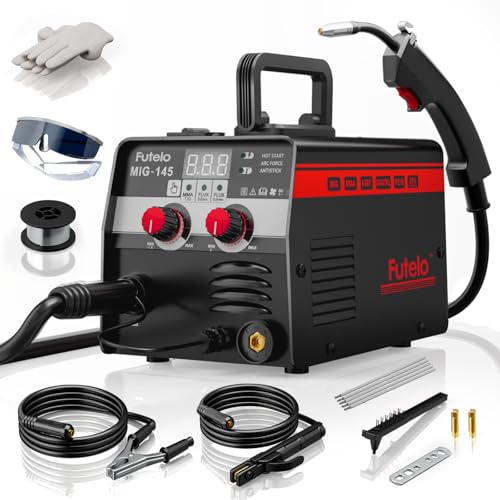
Futelo 145A MIG Welder, 110V 3-in-1 Flux Core Stick Lift TIG, 7.5 lb
The lightest option here at a listed 7.5 lb. A 110V 3-in-1 built around portability for repairs and tight spaces.
Check price on AmazonWhat actually matters on a 120V, 15A circuit
Welding process. Stick (MMA) burns a coated electrode and is forgiving outdoors and on dirty or rusty metal. Flux-core MIG feeds a self-shielded wire, so you get continuous welding without a gas bottle, at the cost of more spatter. Lift TIG is the cleanest process but the slowest to learn and, on budget machines, usually a basic version. All three units list all three processes, so you are not locked into one.
Input amperage and your circuit. This is the part the spec sheet hides. The output amperage on the front panel is not the same as the input current the machine draws from the wall. On 120V, a welder set high can ask for more than a 15A breaker will give, and it trips. A dedicated 20A circuit with proper wiring is the comfortable home for any of these. If you only have a 15A circuit, plan to weld at lower settings on thinner steel, and treat the maker input figures as listing claims to verify, not promises.
Duty cycle. Duty cycle is how many minutes out of ten the machine can weld before it needs to cool. A figure like "60 percent at a given amperage" means six minutes on, four off. Budget machines quote their best duty cycle at modest amperage, so read the number together with the amperage it applies to. We treat every published duty cycle here as a manufacturer claim.
Material thickness. A 120V flux-core or stick setup in this class is happiest on sheet metal and lighter structural steel. Thicker sections mean multiple passes, proper joint preparation, and patience, or a jump to a 240V machine. Do not expect a small 110V unit to lay a single hot pass through thick plate.
What to ignore. Ignore the biggest number on the box. A high peak amperage you cannot reach on your circuit is marketing, not capability. Ignore "3-in-1" as a quality signal on its own, since almost everything in this class claims it. Focus on the voltage it runs on, the output you can actually sustain, and the weight you have to carry.
How the three compare
Think of them as one balanced pick and two specialists. The YESWELDER 135A is the middle path: 110V only, all three processes, and output that fits a home circuit. The HITBOX 200A trades single-outlet simplicity for dual-voltage headroom, which only pays off if you add a 240V plug. The Futelo 145A trades outright power for a 7.5 lb body that goes anywhere.
- Runs on a normal 120V outlet: all three.
- Does stick, flux-core MIG, and lift TIG: all three.
- Dual voltage for a future 240V upgrade: HITBOX 200A only.
- Lightest to carry: Futelo 145A at a listed 7.5 lb.
- Most balanced for everyday home use: YESWELDER 135A.
If you are torn, ask one question: will you ever wire a 240V outlet? If yes, the HITBOX earns its place. If no, the YESWELDER or the Futelo will serve you better, and the choice between them comes down to whether you value a bit more output or a lot less weight.
Safety and setup you should not skip
Welding is not a casual plug-and-play hobby. The arc throws intense ultraviolet light that burns skin and eyes in seconds, the work and the electrode get dangerously hot, and both stick and flux-core give off fumes you must not breathe. Before you strike an arc, put on a proper auto-darkening welding helmet, flame-resistant gloves and clothing, and work in a well-ventilated space or with fume extraction. Keep a fire extinguisher within reach and clear anything flammable from the area.
On the electrical side, follow the maker instructions for the circuit, breaker, and any extension cord. Use the voltage and outlet the manual specifies, do not defeat a breaker to stop it tripping, and if you are unsure about your wiring, have a licensed electrician confirm the circuit or install a dedicated one. Check local codes and permits where they apply. If any of this is beyond your comfort level, hire a professional. A weld that looks fine but was made unsafely is not worth the risk.
Our honest verdict
For the exact need in the question, a compact machine that can stick weld on a standard household circuit, the YESWELDER 135A is the pick we would choose first. It keeps you on one 120V outlet, covers stick, flux-core, and lift TIG, and sits in a sensible output range for home repairs and light fabrication. Pair it with a dedicated 20A circuit if you can.
Pick the HITBOX 200A instead if a future 240V outlet is realistic and you want the extra ceiling for thicker steel. Pick the Futelo 145A if you will carry the machine often and portability outranks power. Whichever you choose, remember that the published amperage and duty-cycle numbers are listing claims, your circuit sets the real limit, and the safety gear is not optional. For more on small welders, see our compact welder guide.