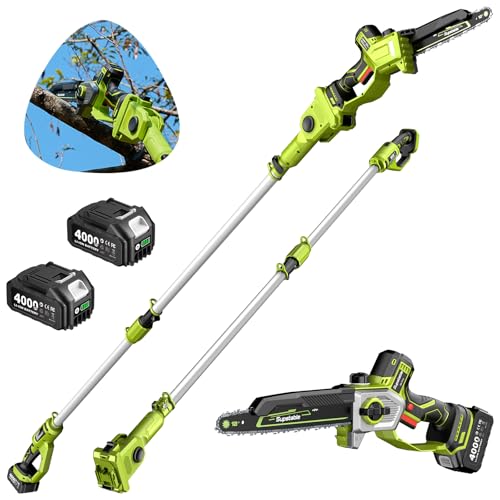
If you want one pole saw that makes overhead pruning feel almost easy, the EGO Power+ Pole Saw is our top pick. Its telescopic pole and LED cut line indicator let you reach high branches and line up each cut with confidence, and it ships with a 56V battery and charger so you can walk the whole yard without a cord trailing behind you. It is the saw we would hand most homeowners who want strong cordless cutting and simple aiming overhead.
Who needs a pole saw, and why it matters
A pole saw is the tool that keeps you off the ladder. Instead of balancing on a rung with a handsaw, you stand on solid ground and let the saw do the reaching. That one change removes the most dangerous part of tree care for most people, which is working at height on an unstable platform. If you have fruit trees to shape, storm damaged limbs to clear, or ornamentals that need yearly thinning, a good pole saw turns a dreaded chore into an afternoon job.
The catch is that pole saws vary more than almost any other yard tool. Some are simple manual blades on an extending pole, with nothing to charge and nothing to break. Others are cordless chainsaws on a telescoping shaft, with brushless motors and batteries that can run through a long session. Choosing well means matching the saw to the height you need, the thickness of the limbs you cut, and how much weight you are willing to hold overhead. Below we name the models we would choose, then explain exactly how to read the specs so you can pick with clear eyes.
How we picked
We build every ProductPickly roundup by studying current Amazon listings for the category, then shortlisting the models whose published specs and features fit the job most homeowners actually face. For pole saws that means weighing stated reach, power type, bar and chain size, weight, oiling, and the quality of the cutting head, then comparing like for like across manual, corded, and battery options. We want to be straight with you about one thing. We have not physically run every unit on this page through a hands on trial. Our picks reflect specification research, feature comparison, and fit for purpose, drawn from the information each maker publishes. Where a listing makes a claim, we report it as the maker states it, and we flag the places where a feature is really a trade off rather than a clear win. That way you get an honest shortlist instead of a wall of identical choices.
What to look for in a pole saw
Reach and pole length. This is the number that decides whether the tool solves your problem at all. Manual poles in this roundup extend as far as 27 feet, while powered saws tend to sit in the 14 to 16 foot class of total working reach once you add your own arm span. Measure the branches you actually need to cut before you buy. Buying more reach than you need means holding extra weight and length for no reason, while buying too little means you are back on the ladder.
Power type. Battery saws are the sweet spot for most yards. They cut quickly, start instantly, and free you from cords, and every powered pick here includes a battery and charger. Corded electric saws trade mobility for unlimited runtime. Gas saws bring the most power for heavy work but add fuel, noise, and maintenance. Manual pole saws need no power at all, which makes them quiet, light, and reliable for lighter pruning. Match the power type to how much you cut and how far you roam.
Bar and chain. On powered models the bar length, here ranging from 8 to 10 inches, sets the thickest limb you can take in a single pass. A longer bar handles bigger wood but adds weight at the end of a long pole, where every extra ounce feels doubled. A sharp, properly tensioned chain cuts faster and safer than a bigger bar run dull, so plan to keep it maintained.
Weight and balance. Specs rarely tell the whole story here, because a saw that feels fine at your side feels very different held at full extension above your head. Lighter is almost always better for overhead control and fatigue, which is one reason manual poles and compact battery saws remain popular. If you have a lot to cut in one session, favor the lightest tool that still has the reach and power you need.
Auto oiling. A chain needs oil to run cool and last. Automatic oiling meters bar oil for you so the chain stays lubricated without you stopping to apply it, which protects both the chain and the bar over time. On a pole saw, where the cutting head is far from your hands, auto oiling is a genuine convenience worth looking for on powered models.
Stay safe up high
Overhead cutting is where a pole saw earns respect. Always watch for overhead power lines and never let the pole, a limb, or yourself get near them. Wear a helmet, eye protection, and ear protection, and keep a clear path to step back as limbs fall. Expect kickback from a powered chain and keep a firm two handed grip with stable footing. Read and follow the manual for your specific saw before the first cut. When branches are close to power lines, or when limbs are large and heavy enough to swing or drop unpredictably, hire a professional rather than taking the risk yourself. No branch is worth an injury.
The bottom line
The EGO Power+ Pole Saw leads our list because it pairs strong cordless cutting with a telescopic pole and an LED cut line indicator that make overhead work feel controlled. If you want the most reach, the Greenworks 60V and the longer manual poles climb higher, while the manual BlumeTrec keeps things simple for lighter pruning with nothing to charge. Pick the reach and power that match your trees, respect the safety basics above, and you will be shaping your canopy from the ground in no time. For more options, browse our pole saw guide and the wider lawn and garden tool guides.