Stud Finders
Best Stud Finders for Any Wall Type
5 picks compared
8 min read
ProductPickly is reader-supported. When you buy through links on our site, we may earn an affiliate commission at no extra cost to you. It never changes our picks.
The short answerOur top pick is the Franklin Sensors ProSensor 710 for its unmatched accuracy and ease of use. It detects wood and metal studs up to 1.5 inches deep with a clear LED display.
?How we pickedWe compare published specifications, safety certifications and thousands of verified owner reviews, and we do not physically test every unit. Read the full process in our review methodology.
Franklin Sensors ProSensor 710
★★★★★ 4.7 / 5 Best overall
The ProSensor 710 uses 13 sensors for a wide detection area and instant readings. It shows stud edges with a bright LED bar, making it fast and accurate for wood and metal studs.
Type ElectronicMax Depth 1.5 inDetection Wood, metal, live ACPower 9V battery
- Wide sensor array for quick scanning
- Clear LED display shows stud edges
- Detects live AC wires
- No calibration needed
- Higher price than basic models
- Not for deep scanning over 1.5 in
Best for: Homeowners and DIYers who need fast, accurate stud detection for hanging shelves, TVs, or cabinets.
Buy it if: Anyone who values time and precision. Great for drywall and standard wood framing.
Skip it if: Professionals needing deep scans for thick walls or concrete. Consider the Bosch GMS120 instead.
Alternative to consider: Zircon MultiScanner i520
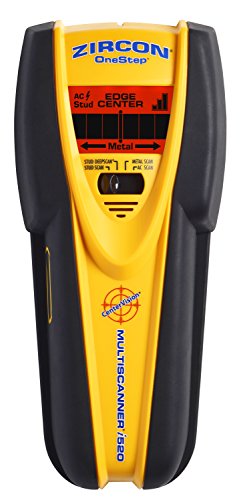
Zircon MultiScanner i520
★★★★★ 4.5 / 5 Best deep scan
The i520 scans up to 1.5 inches deep and includes a dedicated deep scan mode for thicker walls. It also detects live AC wires and has SpotLite Pointing System for precise marking.
Type ElectronicMax Depth 1.5 inDetection Wood, metal, live ACPower 9V battery
- Multiple scanning modes including deep scan
- SpotLite pointer for accurate marking
- Detects live wires
- Good value for features
- Calibration required each use
- Can beep falsely on uneven walls
Best for: Users who need to find studs behind thicker drywall or old plaster.
Buy it if: DIYers and contractors working with varied wall materials.
Skip it if: Those who want instant no-calibration operation. Choose the Franklin ProSensor 710.
Alternative to consider: Franklin Sensors ProSensor 710
CH Hanson 03040 Magnetic Stud Finder
★★★★★ 4.3 / 5 Best magnetic
This simple magnetic finder uses a powerful neodymium magnet to locate drywall screws. No batteries needed. It's reliable for finding metal studs and wood studs with metal fasteners.
Type MagneticMax Depth Up to 3/4 inDetection Metal fasteners, metal studsPower None
- No batteries required
- Simple and reliable
- Works on metal studs
- Inexpensive
- Only finds screws, not stud center
- Limited depth
- Slow process
Best for: Quick checks and metal stud detection. Great for renters or as a backup.
Buy it if: Budget-minded users or those who prefer no electronics.
Skip it if: Anyone needing to find stud centers quickly or scan thick walls.
Alternative to consider: StudPop Magnetic Stud Finder
Bosch GMS120
★★★★★ 4.4 / 5 Best professional
The Bosch GMS120 is a professional-grade multi-scanner that detects wood, metal, and live wires up to 3 inches deep. It differentiates between ferrous and non-ferrous metals and has a backlit display.
Type Electronic deep scanMax Depth 3 inDetection Wood, ferrous/non-ferrous metal, live ACPower 9V battery
- Deep scanning up to 3 inches
- Metal type differentiation
- Backlit display for dark areas
- Automatic calibration
- Higher price
- Bulkier than consumer models
Best for: Contractors and serious DIYers working with thick walls, concrete, or metal studs.
Buy it if: Professionals who need deep scans and metal identification.
Skip it if: Casual home users who only need basic stud finding.
Alternative to consider: Zircon MultiScanner i520
StudPop Magnetic Stud Finder
★★★★★ 4.2 / 5 Best budget
A compact magnetic stud finder with five neodymium magnets that snaps onto drywall screws. It's small enough to fit on a keychain and costs just a few dollars.
Type MagneticMax Depth Up to 1/2 inDetection Metal fastenersPower None
- Extremely affordable
- Keychain size
- Strong magnets
- No batteries
- Only finds screws, not stud edges
- Limited depth
- Can be fiddly
Best for: Budget shoppers and as a portable backup tool.
Buy it if: Anyone needing a cheap, no-fuss solution for occasional use.
Skip it if: Users who want to locate stud centers or scan thick walls.
Alternative to consider: CH Hanson 03040
Finding a stud behind drywall can be frustrating if you use the wrong tool. Our editorial team compared specifications, buyer feedback, and key decision factors across magnetic, electronic, deep-scan, and multi-function stud finders. We evaluated accuracy, ease of use, depth capability, and price to help you choose the best model for your project.
Buying Guide: What to Look For in a Stud Finder
Before you buy, consider the wall type you work with most. Drywall over wood framing is standard, but metal studs, plaster, or concrete require different features. Here are the key factors:
- Detection Type: Electronic stud finders use sensors to detect density changes. Magnetic finders locate screws or metal studs. Electronic models are more versatile but require batteries.
- Scanning Depth: Standard models scan up to 1.5 inches. Deep-scan models can reach 3 inches for thicker walls or concrete. Choose depth based on your wall construction.
- Accuracy: Look for models with multiple sensors or edge-finding capability. The Franklin ProSensor 710 uses 13 sensors for wide, accurate detection without sliding.
- Additional Features: Live AC wire detection is a safety plus. Metal type differentiation helps identify pipes vs. studs. Backlit displays aid in dark areas.
- Ease of Use: Some models require calibration each time, while others are auto-calibrating. Consider how much setup you want.
Common Mistakes When Using a Stud Finder
Even the best stud finder can give false readings if used incorrectly. Avoid these pitfalls:
- Not calibrating on the same wall: Always calibrate on the surface you will scan. Hold the finder flat and press the button until it beeps or lights up.
- Scanning too fast: Move slowly and steadily. Quick passes can miss studs or give inconsistent readings.
- Ignoring wall texture: Popcorn ceilings or textured walls can confuse sensors. Use a magnetic finder as a backup.
- Assuming one pass is enough: Scan in multiple directions and mark edges to find the center. Studs are typically 16 or 24 inches apart.
- Forgetting about live wires: Always use a stud finder with AC detection or a separate wire detector before drilling.
Questions people ask
How does a stud finder work?
Electronic stud finders use capacitance to detect density changes behind drywall. When passed over a stud, the change in dielectric constant triggers an alert. Magnetic stud finders simply attract to drywall screws or metal studs.
Can a stud finder detect metal studs?
Yes. Most electronic stud finders have a metal detection mode. Magnetic stud finders also work well for metal studs because they attract to the metal surface or screws.
What is the best stud finder for concrete walls?
For concrete, you need a deep-scan stud finder like the Bosch GMS120, which can detect metal rebar or conduit up to 3 inches deep. Standard stud finders are not designed for concrete.
Do stud finders detect live wires?
Many electronic stud finders, such as the Franklin ProSensor 710 and Zircon i520, include AC wire detection. They alert you to live electrical wires behind the wall to avoid drilling into them.
Are magnetic stud finders accurate?
Magnetic stud finders are accurate for finding drywall screws but do not show the center or edges of the stud. They are best for locating studs when you already know the approximate location.
The bottom lineSo which one?
For most users, the Franklin Sensors ProSensor 710 offers the best balance of speed, accuracy, and ease of use. If you need deep scanning for thick walls or concrete, choose the Bosch GMS120. For a simple, no-battery option, the CH Hanson 03040 is a reliable classic.