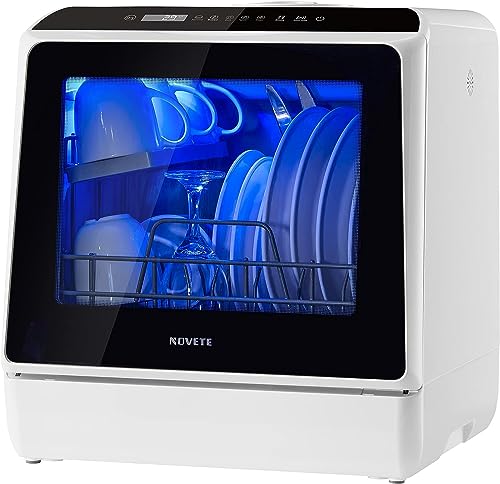
Countertop dishwashers connect to your faucet and plug into a standard outlet.
- They wash with hot water and detergent, then rinse and dry.
- They hold about six place settings and are best for small households.
- Drying methods include heated, fan-assisted, and condensation drying.
- They use 2 to 3 gallons per cycle, less than hand washing but more than full-size units.
What Is a Countertop Dishwasher?
A countertop dishwasher is a compact appliance that sits on your kitchen counter. It measures about 18 inches wide, 20 inches deep, and 18 inches tall. Most weigh between 40 and 50 pounds. They hold roughly six place settings, which is fewer than full-size models. They are ideal for apartments, RVs, or small households.
How Does a Countertop Dishwasher Connect to Water?
Most countertop dishwashers connect directly to your kitchen faucet. They come with a Y-adapter that splits the water flow. One side feeds the dishwasher, the other keeps your faucet usable. A hose runs from the adapter to the machine. Some models offer a permanent connection to your water line. The drain hose attaches to the sink or a drain point.
What Happens Inside During a Wash Cycle?
You load dishes, add detergent, and select a cycle. The machine fills with water from your faucet. A heating element warms the water to around 140 degrees Fahrenheit. A spray arm at the bottom shoots water upward to clean dishes. The pump circulates water through the spray arm. After washing, it drains the dirty water and rinses with fresh water.
How Does a Countertop Dishwasher Dry Dishes?
Drying methods vary by model. Many use a heating element to evaporate water. Others rely on a fan that circulates air. Some models use condensation drying, where cold water cools the interior. Heated drying is faster but uses more energy. Air-dry settings save electricity but take longer. Check the specs to see which method a model uses.
What Are the Limitations of Countertop Dishwashers?
Countertop dishwashers have smaller capacities than full-size units. They cannot wash large pots or baking sheets. They also use more water per load than full-size models. You must keep the counter space clear for the machine. They are not suitable for permanent installation in most homes. They work best for singles, couples, or small families.