Multimeters
Best Multimeters: Picks for Home, Auto and HVAC Electrical Work
7 picks compared
8 min read
ProductPickly is reader-supported. When you buy through links on our site, we may earn an affiliate commission at no extra cost to you. It never changes our picks.
The short answerA digital multimeter reads voltage, resistance and current, and most add continuity and a few extra functions. Our overall pick is the Crenova MS8233D: it is listed as a true RMS, 6000-count, auto-ranging meter with live-wire NCV, which covers most home and hobby jobs. Choose by how you work. True RMS, listed on the Crenova, FNIRSI, FS899L and Fieldpiece, reads distorted AC accurately; auto-ranging sets the range for you; and a clamp meter like the AstroAI or Fieldpiece reads current without breaking the circuit. The KAIWEETS is the fused budget pick and the Klein kit bundles outlet and voltage testers. Whatever you pick, match the meter's safety rating and voltage limit to the job.
?How we pickedWe compare published specifications, safety certifications and thousands of verified owner reviews, and we do not physically test every unit. Read the full process in our review methodology.
Crenova MS8233D True RMS 6000 Count Auto-Ranging Multimeter
★★★★★ 4.7 / 5 Editor's pick
The Crenova MS8233D is listed as a true RMS meter with 6000 counts and auto-ranging, which is why it is our overall pick for most home and hobby use. The live-wire NCV feature lets you flag a hot wire before you touch it, a useful safety step for outlet and fixture work.
- True RMS reads AC more accurately
- Auto-ranging picks the range for you
- NCV flags live wires without contact
- Measurement ranges beyond the listing are not stated
- No CAT safety rating stated in the listing
Best for: A general home and electronics all-rounder that handles AC accurately
KAIWEETS Digital Multimeter with Anti-Burn Double Fuses
★★★★★ 4.5 / 5 Budget pick
This KAIWEETS meter is listed with an anti-burn design and double fuses, which is reassuring for a beginner learning to probe live circuits. It covers AC and DC voltage, resistance, current, continuity and a diode test, and the listing names household outlet and automotive battery checks.
- Double-fuse anti-burn design as listed
- Covers voltage, resistance, current, continuity and diode
- Case included for storage
- No true RMS or count stated in the listing
- No CAT safety rating stated in the listing
Best for: A cautious beginner who wants fused protection on a budget
Klein Tools MM320KIT Multimeter Electrical Test Kit
★★★★★ 4.6 / 5 Trusted brand pick
The Klein MM320KIT pairs a digital multimeter with a non-contact voltage tester and a receptacle tester, so it covers meter readings and quick outlet checks in one kit. Klein is a long-established name in hand tools, and the listing includes a carrying case and batteries to get started.
- Klein is a widely trusted tool brand
- Bundles NCV and receptacle testers with the meter
- Case and batteries included
- Count, true RMS and ranges are not stated in the listing
- A three-piece kit is more than a single-meter buyer needs
Best for: A home electrical kit that bundles outlet and voltage checks with the meter
FNIRSI DMT-99 True RMS 9999 Count Rechargeable Multimeter
★★★★★ 4.4 / 5 High count pick
The FNIRSI DMT-99 is listed with a 9999-count display and true RMS, a step up in resolution from the usual 2000 to 6000 count budget meters. It is rechargeable, so you top it up over USB rather than swapping disposable cells.
- High 9999-count resolution as listed
- True RMS for AC measurement
- Rechargeable, so no disposable batteries
- Full measurement ranges are not stated in the listing
- No CAT safety rating stated in the listing
Best for: A hobbyist who wants higher display resolution and a rechargeable battery
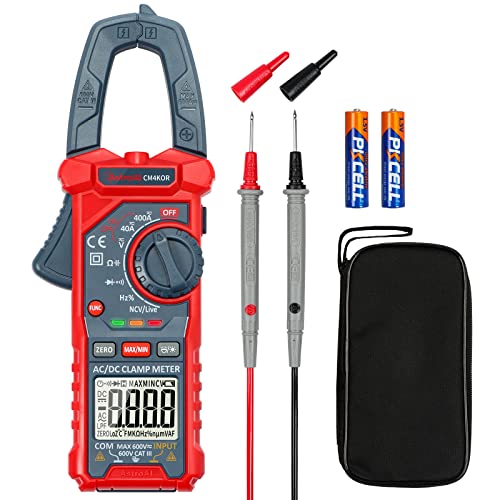
AstroAI Digital Clamp Meter, 4000 Count Auto-Ranging
★★★★★ 4.4 / 5 Clamp meter pick
The AstroAI is a clamp meter, a close cousin of the probe multimeter that reads current by clamping around a single conductor instead of breaking the circuit. The listing adds AC and DC voltage, resistance, capacitance, frequency, continuity and NCV, so it doubles as a general meter.
- Clamp jaw reads current without breaking the circuit
- Auto-ranging across many functions
- Live-wire and NCV detection as listed
- A clamp body is bulkier than a pocket probe meter
- No CAT safety rating stated in the listing
Best for: Measuring current on a wire without cutting into the circuit
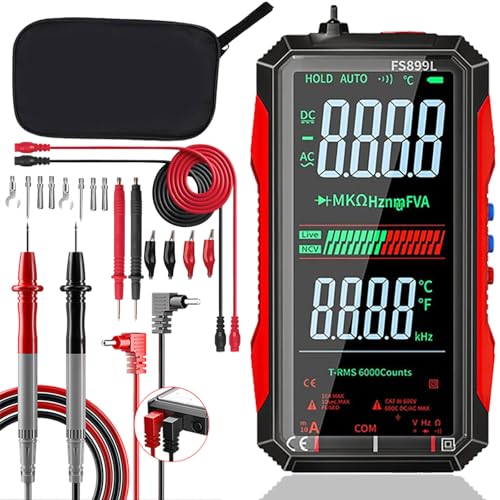
FS899L True RMS Auto-Ranging Multimeter, USB-C Color Screen
★★★★★ 4.3 / 5 Rechargeable pick
The FS899L is listed as a true RMS auto-ranging meter with a color screen and USB-C recharging, a more modern take than the usual segmented LCD. It comes with a silicone test-leads kit and lists AC and DC voltage, NCV and capacitance.
- Color screen and USB-C recharging as listed
- True RMS with auto-ranging
- Ships with a test-leads kit as listed
- No CAT safety rating stated in the listing
- Color screen and extras are more than a basic user needs
Best for: Someone who wants a rechargeable color-screen meter with test leads included
Fieldpiece SC260 Compact HVACR True RMS Clamp Multimeter
★★★★★ 4.5 / 5 HVAC pro pick
The Fieldpiece SC260 is a compact true RMS clamp meter aimed at HVACR work, adding temperature and capacitance to the usual current and voltage readings. A backlight helps in dim equipment spaces, and Fieldpiece is a specialist name in HVACR tools.
- Built for HVACR with temperature and capacitance
- True RMS clamp for current readings
- Backlight for dim spaces
- Aimed at HVACR work, more than a basic home user needs
- No CAT safety rating stated in the listing
Best for: HVACR technicians who need temperature and capacitance in a clamp meter
A digital multimeter is the one tester that belongs in every toolbox: it reads voltage, resistance and current, and most add continuity and a handful of extra functions. The picks below are genuine digital multimeters and clamp meters from the feed, and we list only the features each listing actually states. Rather than chase the biggest spec sheet, the honest way to choose is to match four things to your work: whether you need true RMS, whether you want auto-ranging, whether a clamp meter suits you better than a probe meter, and whether the safety rating fits the circuits you touch.
Auto-ranging versus manual ranging
The first practical choice is how the meter selects its range. An auto-ranging meter decides for you: you turn the dial to voltage or resistance, touch the probes, and it figures out whether you are reading millivolts or hundreds of volts and shows the number. A manual-ranging meter makes you pick the range yourself, which is faster once you know roughly what to expect but frustrating for a beginner who guesses wrong and sees a blank or overload reading. Most of the picks here, including the Crenova MS8233D, the AstroAI clamp and the FS899L, list auto-ranging, which is the gentler starting point. The trade-off is small: auto-ranging can take a moment to settle on a range, so some experienced users still prefer manual control for repeated readings on a known circuit. For general home, auto and hobby work, auto-ranging is the one to reach for.
True RMS and what a meter measures
Every meter here reads the core quantities: AC and DC voltage, resistance in ohms and current in amps, with continuity for a quick connected-or-not beep. The feature that separates them is true RMS. A basic averaging meter assumes AC is a clean sine wave and can read it wrong when the waveform is distorted, which happens around motors, dimmers, variable-speed drives and a lot of modern electronics. A true RMS meter measures the real heating value of the signal and stays accurate on those messy waveforms, which is why the Crenova, FNIRSI, FS899L and Fieldpiece picks list it. Beyond the basics, listings here add diode testing, capacitance, frequency and non-contact voltage, so look past the headline and check that the specific functions you need, such as capacitance for a motor-run capacitor, are actually on the meter you choose.
Clamp meter versus probe meter
A standard probe multimeter measures current by putting itself in the circuit: you break the connection and route the current through the meter, which is clumsy and limited to modest currents through the meter fuse. A clamp meter takes a different route, reading current through a hinged jaw that closes around a single conductor with nothing disconnected. The AstroAI and the Fieldpiece SC260 in this list are clamp meters, close cousins of the probe meter that still read voltage, resistance and more, but shine when you need to measure the current a live appliance or motor is drawing. If your work is mostly bench electronics and outlet checks, a probe meter like the Crenova or KAIWEETS is simpler and more pocketable. If you regularly check current on live household, automotive or HVAC wiring, the clamp is the safer and faster tool, which is why the HVACR-focused Fieldpiece leans on it.
CAT safety ratings and safe use
The most important spec is also the one buyers skip: the safety rating. Meters and their leads carry a CAT rating, from CAT I through CAT IV, that describes the transient voltage surge they are built to survive, with the higher numbers meant for circuits closer to the incoming mains supply where surges are largest. The rule is to match the CAT rating and the voltage limit to the job, and never to use a meter on a circuit beyond what it is rated for. None of these listings state a CAT rating, so before you measure anything near mains voltage, read the rating printed on the meter body and on the leads themselves, and treat the lower of the two as your limit. Inspect the leads for cracked insulation or exposed metal, keep one hand away from the circuit where you safely can, start on a known-live source to confirm the meter works, and if a reading looks impossible, stop and check the meter rather than trusting the number. A multimeter is a safety tool only when it is matched to the circuit and in good condition.
Questions people ask
What is a digital multimeter and what can it measure?
A digital multimeter, or DMM, is a handheld tester that combines several meters in one. At minimum it reads AC and DC voltage, resistance in ohms, and current in amps, and most add continuity, which beeps when two points are connected. Many of the picks here also list a diode test, capacitance, frequency or non-contact voltage detection, so the right meter depends on which of those jobs you actually do.
What does true RMS mean and do I need it?
True RMS, or root mean square, is a method of measuring AC that stays accurate when the waveform is not a clean sine wave, which is common around motors, dimmers and electronic loads. A cheaper averaging meter can read those distorted signals wrong. The Crenova, FNIRSI, FS899L and Fieldpiece picks list true RMS, so if you work on anything beyond simple wall power it is worth having.
What is auto-ranging versus manual ranging?
An auto-ranging meter picks the correct measurement range for you, so you just choose voltage or resistance and read the number. A manual meter makes you select the range yourself, which is faster once you know the circuit but fiddly for a beginner. Several picks here, including the Crenova, AstroAI and FS899L, list auto-ranging, which is the friendlier choice while you are learning.
What do counts mean on a multimeter?
Counts describe the resolution of the display, meaning the highest number it can show before it has to switch ranges. A 6000-count meter can display up to 5999, while a 9999-count meter like the FNIRSI shows finer detail before rounding. More counts help with precise electronics work, but for checking outlets, batteries and continuity a 2000 to 6000 count meter is usually plenty.
Clamp meter or probe multimeter: which do I need?
A standard probe multimeter measures current by breaking the circuit and routing it through the meter, which is awkward and limited to small currents. A clamp meter, like the AstroAI and Fieldpiece picks, reads current by clamping its jaw around a single wire, with no need to cut in. If you measure current on live household or motor circuits, a clamp meter is safer and far more practical; for bench electronics a probe meter is fine.
What is NCV detection?
NCV stands for non-contact voltage. A meter with NCV has a sensor near the tip that lights or beeps when it is close to a live wire, without touching any metal. It is a quick first check to confirm a wire is dead before you work on it. The Crenova, AstroAI and FS899L picks list NCV, but treat it as a warning aid, not a substitute for a direct voltage reading.
What do CAT safety ratings mean and how do I stay safe?
CAT ratings, from CAT I up to CAT IV, describe the level of transient voltage surge a meter and its leads are built to survive, with higher numbers for circuits closer to the incoming mains supply. The rule is simple: match the CAT rating and voltage limit to the job, and never use a meter on a circuit that exceeds what it is rated for. None of these listings state a CAT rating, so check the rating on the meter and its leads before measuring mains, confirm the leads are undamaged, keep one hand off the circuit where possible, and when a reading looks wrong, stop rather than assume the meter is right.
Which multimeter should a beginner choose?
For a first meter, auto-ranging and some built-in protection matter more than a long spec sheet. The KAIWEETS pick lists an anti-burn design with double fuses and a case, which suits a cautious beginner, while the Crenova adds true RMS and auto-ranging for a little more capability. If you want outlet checks bundled in, the Klein kit includes a non-contact voltage tester and a receptacle tester alongside the meter.
The bottom lineSo which one?
Pick by the work you do, not by the longest spec list. The Crenova MS8233D is our overall pick because true RMS, auto-ranging and 6000 counts cover most home and electronics jobs, with NCV to flag a live wire first. The KAIWEETS is the fused budget choice for a careful beginner, and the Klein MM320KIT bundles a non-contact voltage tester and a receptacle tester with the meter. The FNIRSI adds 9999-count resolution and the FS899L a rechargeable color screen. If you measure current on live wiring, the AstroAI clamp meter and the HVACR-focused Fieldpiece SC260 read it without cutting into the circuit. Above all, match the meter's safety rating and voltage limit to the circuit, and never exceed what it is rated for.