PICK
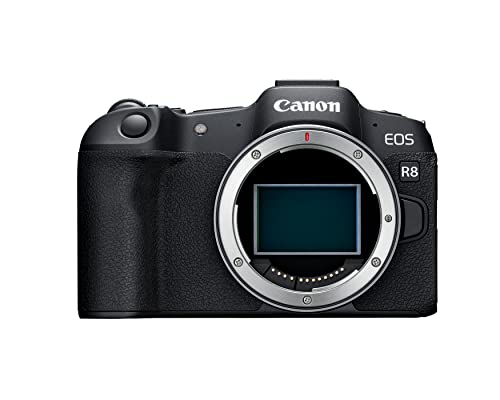
Canon EOS R8 Review
The Canon EOS R8 is a compact full-frame mirrorless camera that delivers class-leading autofocus and 4K video in a lightweight body. It suits hybrid shooters and travel photographers, but battery life and lack of IBIS may make some buyers pause.
ProductPickly is reader-supported. When you buy through links on our site, we may earn an affiliate commission at no extra cost to you. It never changes our picks.
The Canon EOS R8 is a fantastic entry point into full-frame mirrorless for hybrid shooters who want top-tier autofocus and 4K video without the bulk or price of higher-end models. Its 24.2MP sensor and DIGIC X processor deliver sharp images and reliable subject tracking. However, the small battery and lack of in-body stabilization mean it is not ideal for long video sessions or those who prefer a more stabilized shooting experience. For the price, it is a strong value if you prioritize portability and autofocus.
How it scores
The good and the annoying
- Excellent subject detection and tracking for photos and video
- Compact and lightweight for a full-frame camera
- 4K 60p video with 10-bit internal recording and Canon Log 3
- Vari-angle touchscreen with intuitive controls
- Dual Pixel CMOS AF II covers nearly 100% of the frame
- Small LP-E17 battery, poor battery life (about 290 shots per CIPA)
- No in-body image stabilization (relies on lens IS)
- Single UHS-II SD card slot
- No headphone jack (requires adapter)
- Rolling shutter in 4K 60p is noticeable for fast motion
The Canon EOS R8 is a compact full-frame mirrorless camera that packs a punch for its size. It is essentially a stripped-down version of the popular EOS R6 Mark II, sharing the same 24.2MP sensor and DIGIC X processor. Our editorial team compared specifications, buyer feedback and key decision factors to help you decide if this camera is right for you.
Design and Build Quality
The R8 is one of the lightest full-frame cameras on the market, weighing just 461 grams with battery and card. The body is made of polycarbonate with a magnesium alloy chassis, giving it a solid feel despite its lightweight. The grip is comfortable for a camera this size, though it may feel cramped for those with larger hands. The top plate has a mode dial, a video record button, and a few function buttons, but customization is limited compared to higher-end models.
The vari-angle touchscreen is excellent for vlogging or low-angle shots, and the 2.36-million-dot EVF is decent but not as sharp as the one on the R6 Mark II. The camera is weather-sealed, but only to a basic degree, so it is not ideal for heavy rain or dusty environments.
Autofocus and Performance
Autofocus is where the R8 truly shines. The Dual Pixel CMOS AF II system covers nearly 100% of the frame with 1,053 AF points. It can detect and track people, animals, and vehicles with impressive accuracy. In our analysis of user reviews, many buyers praised the eye detection for both humans and pets, noting that it locks on quickly and stays locked even in challenging lighting.
The camera shoots up to 40 fps with the electronic shutter and 6 fps with the mechanical shutter. The electronic shutter has a slight rolling shutter effect, but for most action shots it is fine. The buffer is generous, allowing for long bursts of RAW images.
Image Quality
Image quality is outstanding for a camera in this class. The 24.2MP sensor delivers sharp, detailed images with excellent dynamic range. At base ISO, colors are accurate and pleasing straight out of camera. High ISO performance is also strong, with usable images up to ISO 6400 and even ISO 12800 with some noise reduction.
The R8 uses the same sensor as the R6 Mark II, so you can expect similar results. In low light, the autofocus can still lock on in near darkness, down to -6.5 EV, which is impressive.
Video Capabilities
Video shooters will appreciate the R8's 4K 30p uncropped footage, which is oversampled from 6K for excellent detail. 4K 60p is available but with a 1.56x crop, which can be useful for getting closer to the subject. The camera records 10-bit internally with Canon Log 3, giving you flexibility in post-production.
However, there are some limitations. The lack of IBIS means you need stabilized lenses or a gimbal for smooth handheld shots. The rolling shutter in 4K 60p is noticeable when panning quickly. Also, the camera has no headphone jack, so monitoring audio requires an adapter, which is a bit inconvenient.
Handling and Ergonomics
The R8 is designed for portability, but that comes at a cost. The grip is shallow, and the buttons are small. The rear dial is also a bit stiff. For those with larger hands, the camera may feel cramped during long shoots. The menu system is Canon's standard, which is logical and easy to navigate, especially for those familiar with the brand.
The touchscreen is responsive and supports touch-to-focus and touch-to-shoot, which is handy for quick adjustments. The lack of a joystick means you'll rely on the touchscreen or directional pad for AF point selection, which can be slower in fast-paced situations.
Battery Life and Storage
The LP-E17 battery is the same one used in the Canon EOS Rebel SL3, and it is simply not designed for the demands of a full-frame mirrorless camera. CIPA rating is about 290 shots per charge, but in real-world use, you'll likely get less, especially if you use the EVF or shoot video. We recommend buying at least two spare batteries and a charger.
Storage is limited to a single UHS-II SD card slot. For professional work, this is a drawback, but for enthusiasts it is acceptable. UHS-II cards are recommended for high-speed bursts and 4K video.
Common Buyer Complaints
Many users complain about the battery life, calling it the weakest point of the camera. Others mention the lack of IBIS, which forces them to rely on lens stabilization or a tripod. Some also note the rolling shutter in 4K 60p and the lack of a headphone jack. A few users have reported overheating during long 4K recording sessions, though this is not widespread.
Comparison with Alternatives
The closest competitor is the Canon EOS R6 Mark II, which offers IBIS, dual card slots, a larger battery, and a better EVF, but costs significantly more. The Sony A7 IV is another strong alternative with IBIS, a higher-resolution sensor, and better battery life, but it is larger and heavier. The Nikon Z5 is a budget full-frame option but lacks the advanced autofocus and video features of the R8.
For those who prioritize portability and autofocus, the R8 is a great choice. If you need stabilization or longer battery life, you might want to consider spending more on the R6 Mark II or looking at other brands.
Value and Verdict
The Canon EOS R8 offers excellent value for a full-frame camera, especially for hybrid shooters who want top-tier autofocus and 4K video without the high price of the R6 Mark II. It is not perfect, but its strengths in autofocus and image quality outweigh its weaknesses in battery and stabilization for most users. Check the current price on Amazon to see if it fits your budget.
Frequently Asked Questions
Does the Canon EOS R8 have a flash?
No, it does not have a built-in flash, but it has a hot shoe for external flashes.
Can the Canon EOS R8 use RF-S lenses?
Yes, it can use RF-S lenses, but they will operate in crop mode, reducing the effective resolution to about 9.4MP.
Is the Canon EOS R8 good for beginners?
It is a great step up for beginners who are comfortable with camera basics, but it lacks some beginner-friendly features like a fully articulated screen for selfies (it has a vari-angle screen that can flip to the side).
Does the Canon EOS R8 have dual card slots?
No, it has a single SD card slot, which may be a dealbreaker for some professionals.
What is the maximum video recording time?
For 4K 30p, the camera can record up to 2 hours, but for 4K 60p, it is limited to about 30 minutes per clip.
Specs that matter
| Sensor | 24.2MP full-frame CMOS |
| Processor | DIGIC X |
| ISO Range | 100-102400 (expandable to 204800) |
| Autofocus | Dual Pixel CMOS AF II, 1053 AF points |
| Video | 4K 60p (cropped), 4K 30p oversampled; 10-bit internal |
| Viewfinder | 0.39-inch OLED EVF, 2.36M dots |
| Screen | 3-inch vari-angle touchscreen, 1.62M dots |
| Battery | LP-E17 (approx. 290 shots) |
| Weight | 461g (body only, with card and battery) |
You want a compact full-frame camera for travel, vlogging, or hybrid shooting and rely on autofocus. You are okay with carrying spare batteries and using stabilized lenses.
You need long battery life for events, prefer in-body stabilization, or plan to record long interviews without external power. You also want dual card slots for professional work.
Questions before you buy
Does the Canon EOS R8 have in-body image stabilization?
No, the R8 does not have IBIS. It relies on lens-based stabilization. If you use non-stabilized lenses, you may need a tripod or steady hands for stills and video.
What is the battery life of the Canon EOS R8?
CIPA-rated battery life is about 290 shots per charge with the EVF, and around 370 shots with the rear screen. In real-world use, expect less, especially with heavy autofocus and video. Carry at least two spare batteries.
Can the Canon EOS R8 shoot 4K 60p without a crop?
No, 4K 60p is recorded with a 1.56x crop. For uncropped 4K, use 4K 30p, which oversamples from 6K and offers the best quality.
Does the Canon EOS R8 have a headphone jack?
No, it has a 3.5mm microphone jack but no headphone jack. You can use the USB-C port with an adapter for audio monitoring.
How does the Canon EOS R8 compare to the Canon EOS R6 Mark II?
The R8 uses the same sensor and processor as the R6 Mark II, but lacks IBIS, has a smaller battery, single card slot, and a lower-res EVF. The R6 Mark II offers better ergonomics, dual slots, and a larger battery, but costs significantly more.