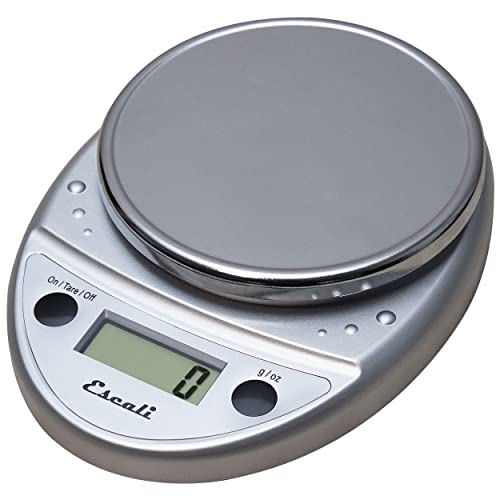
Choose a scale with 0.1 gram readability for measuring small amounts.
- Look for repeatability and a tare function to ensure consistent readings.
- Test accuracy with a known weight, like a nickel, to verify performance.
What makes a kitchen scale accurate for small amounts?
Accuracy for small amounts hinges on readability, which is the smallest weight increment a scale can display. A scale with 0.1 gram readability can measure a single gram with precision. Repeatability matters too, meaning the scale gives the same reading for the same weight every time. Look for a scale with a high resolution sensor, often indicated by a higher price. Calibration features also help maintain accuracy over time. Finally, a stable platform and anti-slip feet reduce errors from movement.
Which type of scale is best for measuring tiny quantities?
Digital scales outperform analog ones for small amounts. They offer precise digital readouts and tare functions. For micro amounts, consider a jeweler's scale, but kitchen scales with 0.1 gram readability are sufficient for most cooking. Look for scales with a 'g' mode and a low minimum weight, such as 1 gram or less. Some scales have a 'precision' mode that increases sensitivity. Avoid scales with 1 gram readability if you need to measure under 5 grams.
Best kitchen scales for spices, yeast, and baking
For baking, a scale with 0.1 gram readability is essential for yeast and leavening agents. The Escali Primo offers 0.1 gram readability and a compact design. The Ozeri Pro has a tare function and a backlit display, ideal for low light. The AWS-100 is a digital scale with 0.1 gram accuracy and a stainless steel platform. Owners report consistent results for small quantities. These scales also handle larger weights up to 11 pounds, making them versatile.
How to test and verify your scale's accuracy
Use a known weight, like a nickel (5 grams), to check accuracy. Place the coin on the scale and see if it reads 5.0 grams. Repeat the test several times to check repeatability. If the scale has a calibration mode, use a calibration weight. Many scales come with a calibration weight or allow manual calibration. Also, ensure the scale is on a flat, stable surface. Avoid using it near drafts or vibrations.
Edge cases: measuring under 1 gram and micro-dosing
For amounts under 1 gram, even 0.1 gram scales may struggle. Consider a scale with 0.01 gram readability, like a jeweler's scale, but these have lower max capacities. For micro-dosing supplements, a scale like the AWS-100 with 0.1 gram is often enough. However, for precise micro-dosing, a 0.01 gram scale is better. Remember that environmental factors, like humidity, can affect readings. Always use the tare function to zero out containers.