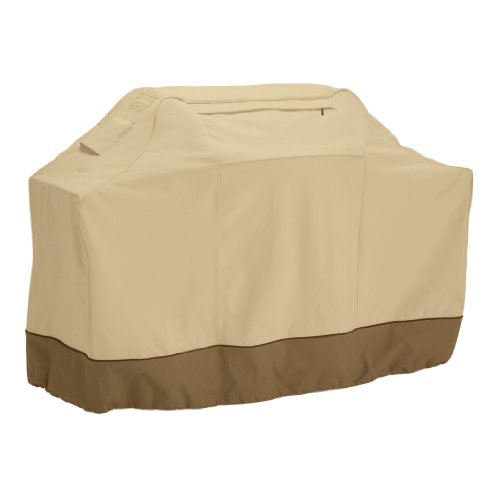
A grill cover that fits perfectly protects your investment from rain, snow, and sun. But a cover that is too small is a struggle to put on, and one that is too large can flap in the wind and let moisture in. The key is accurate measurement. Our editorial team compared specifications, buyer feedback, and key decision factors to bring you a straightforward guide. Follow these steps, and you will find a cover that slides on easily and stays put.
Why Accurate Measurements Matter
Grill covers are not one-size-fits-all. Manufacturers design covers for specific grill shapes and sizes. A cover that is too small may not cover the side shelves or the handles, leaving those parts exposed to the elements. A cover that is too large can collect water on top, causing sagging and potential tearing. Accurate measurements ensure you get a cover that fits snugly but not tightly, providing maximum protection.
Most covers list dimensions in the product description, but those numbers are often the maximum dimensions the cover can accommodate. If your grill is at the upper limit of that range, the cover may be too tight. Measuring your grill first helps you compare with the cover's dimensions and choose the right size.
Step-by-Step Measuring Guide
To measure your grill, you will need a tape measure, a notepad, and a pen. It helps to have a second person to hold the tape measure for larger grills. Follow these steps:
- Prepare the grill: Ensure the grill is cool and the lid is closed. If your grill has side shelves, fold them down if they are collapsible, or leave them in the open position if they are fixed. For the most accurate fit, measure with the shelves in the position you will use them most often, which is usually open.
- Measure the width: Place the tape measure at the leftmost point of the grill, including any side shelves or handles. Stretch it to the rightmost point. Write down this number. If your grill has a side burner, include it in the width measurement. If the shelves are removable, you can measure without them, but remember that the cover must fit over them when they are attached.
- Measure the depth: Measure from the front of the grill (including the handle) to the back. This includes any protruding parts like the handle or the back shelf. Make sure the tape measure is parallel to the ground.
- Measure the height: Measure from the ground to the highest point of the grill, which is usually the top of the lid or the chimney if you have one. If your grill has a side shelf that is higher than the lid, include that in the height measurement. For grills with a cart or wheels, measure from the bottom of the wheels to the top.
- Record the measurements: Write down the width, depth, and height in inches. Double-check each measurement to ensure accuracy.
If your grill has an unusual shape, such as a kettle grill or a kamado, measure the widest and tallest points. For a kettle grill, measure the diameter of the bowl. For a kamado, measure the circumference if you are looking for a cover that wraps around, but most covers are sized by diameter.
Choosing the Right Allowance
Once you have the exact dimensions, you need to decide how much extra space to allow. A cover that fits too tightly is difficult to put on and may tear at the seams. A cover that is too loose can blow off or allow water to pool on top. The ideal allowance is 2 to 4 inches in width and depth, and 1 to 2 inches in height.
For example, if your grill measures 60 inches wide, 28 inches deep, and 45 inches high, look for a cover that is at least 62 to 64 inches wide, 30 to 32 inches deep, and 46 to 47 inches high. This extra space makes it easy to slide the cover over the grill without having to wrestle with it. It also allows for the thickness of the cover material, which can take up a little space.
Keep in mind that some covers have adjustable straps or elastic hems that help secure the cover. These features can compensate for a slightly larger fit. If you are between sizes, choose the larger size, as it is easier to adjust a loose cover than to stretch a tight one.
Also consider the shape of your grill. If you have a grill with a tall chimney or a rotisserie motor, you may need extra height. Measure those protruding parts separately and add them to your height measurement. For side shelves, measure the full width with the shelves open, as most covers are designed to fit over them.
Finally, check the product description for the cover's dimensions, not just the grill size it claims to fit. Compare those dimensions with your measurements. If the cover's dimensions are close to your grill's measurements, it will fit well. If they are significantly larger, the cover may be too loose.
By following these steps, you can confidently choose a cover that fits your grill perfectly. A well-fitted cover will protect your grill for years, saving you money on repairs and replacements.